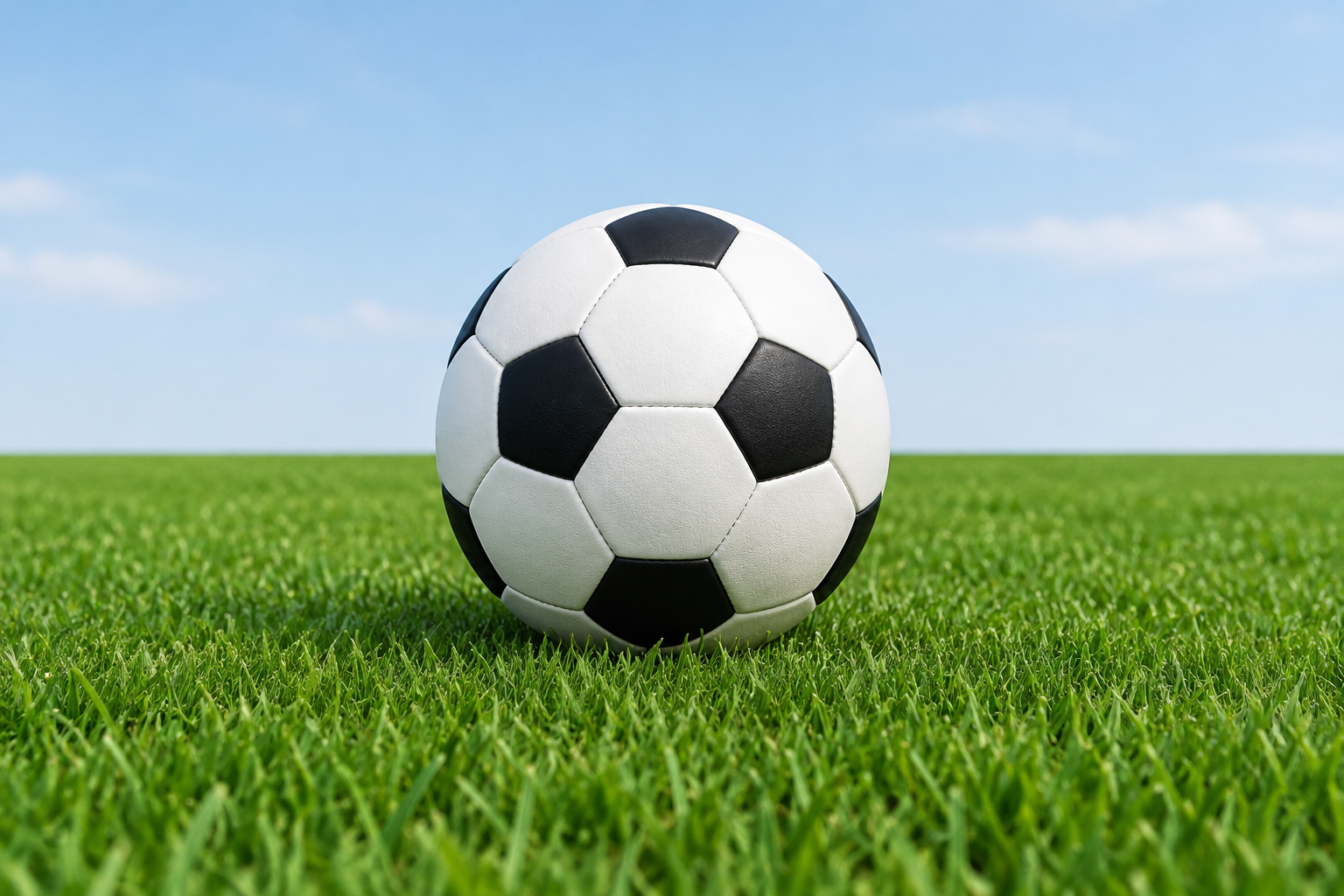
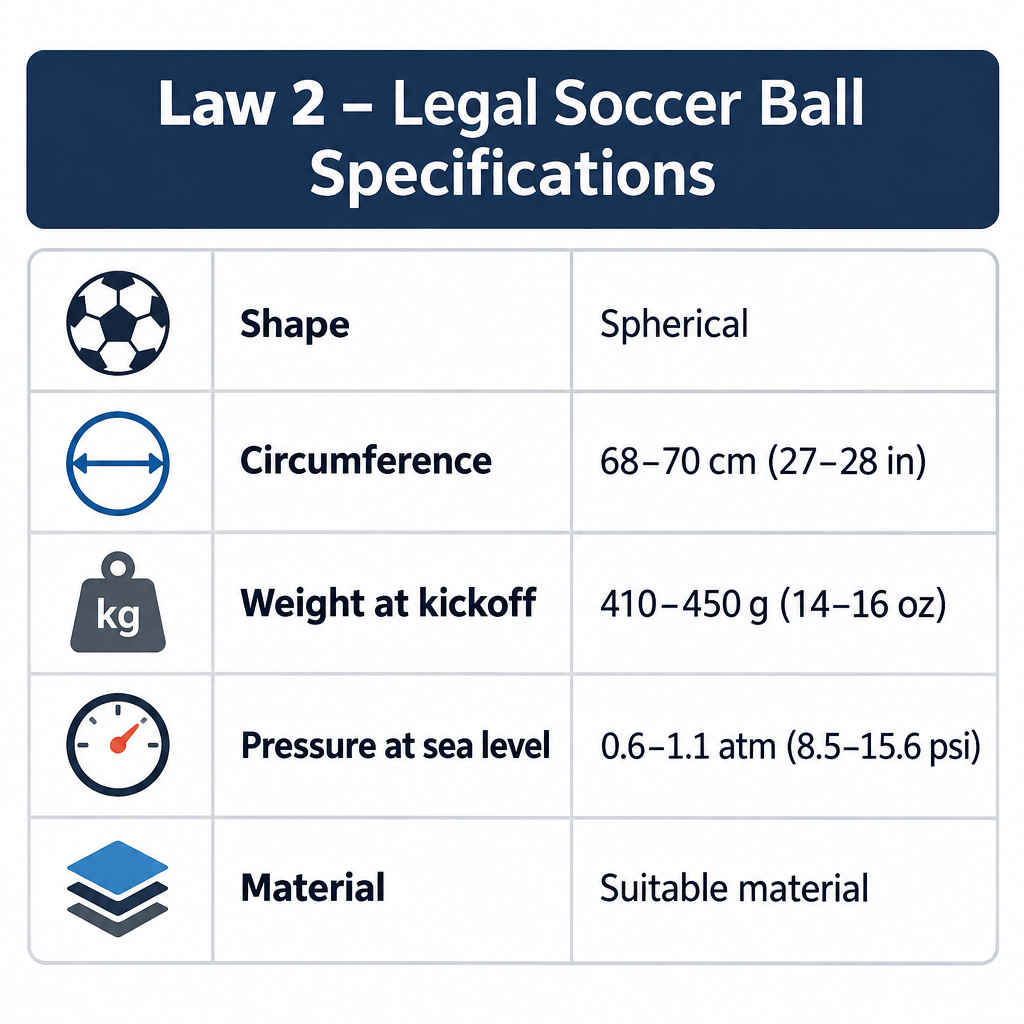
A legal soccer ball is spherical, made of suitable material, 68 to 70 cm around, 410 to 450 g at kickoff, and inflated to 0.6 to 1.1 atmospheres at sea level. Those numbers come straight from Law 2 of the IFAB Laws of the Game. Top competitions add a quality mark and limits on logos. Below we cover each rule, how referees apply it, and what it means when you buy soccer balls for your own games.
The five specs in Law 2
Law 2 is one of the shortest Laws in the book. It still settles every argument about what counts as a legal soccer football ball. These are the core requirements.
| Spec | Law 2 requirement | Imperial equivalent |
|---|---|---|
| Shape | Spherical | n/a |
| Material | “Suitable material” | n/a |
| Circumference | 68 to 70 cm | 27 to 28 in |
| Weight at start of match | 410 to 450 g | 14 to 16 oz |
| Pressure at sea level | 0.6 to 1.1 atmosphere (600 to 1,100 g/cm²) | 8.5 to 15.6 psi |
These figures describe what most people call a size 5 ball. The Laws never use the word “size.” They only give the measurements.
The weight rule has a detail that matters. The 410 to 450 g window applies at the start of the match. A ball that soaks up rain and gets heavier in the second half is still legal.
“Suitable material” is deliberately vague. Leather, synthetic leather and modern polyurethane covers all qualify. The IFAB leaves the engineering to manufacturers and the testing to quality programs.
Ref's note
Pressure is the spec that varies most. The legal range is wide, from 8.5 to 15.6 psi. Referees check the ball before kickoff, and a ball can be legal but still feel very different from one game to the next.
Quality marks for top competitions
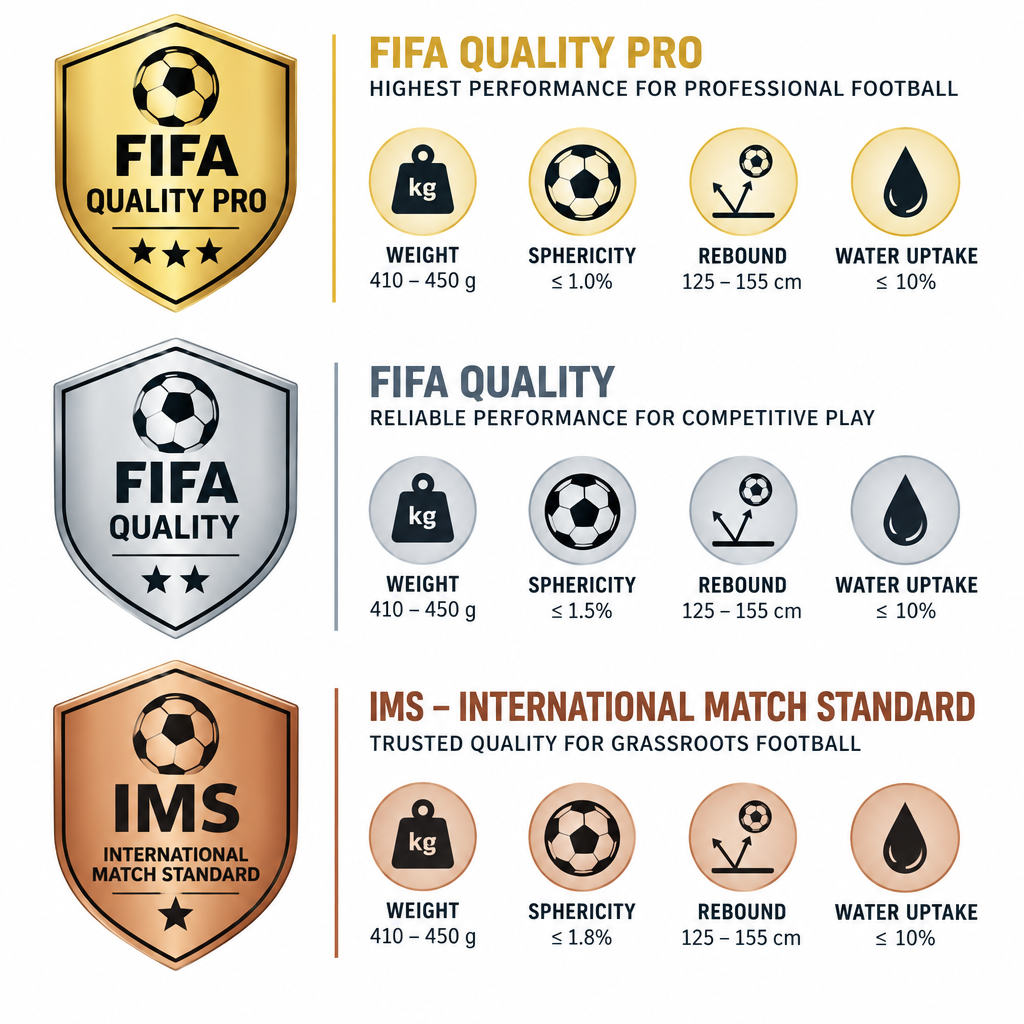
Law 2 adds a second layer for elite soccer. In official competitions organized under FIFA or the confederations, every match ball must carry one of three marks:
- FIFA Quality Pro
- FIFA Quality
- IMS (International Match Standard)
Each mark shows that the ball was tested by FIFA’s quality program. The tests go beyond the basic Law 2 numbers. Labs check things like weight, circumference, sphericity, rebound, water uptake and how well the ball holds its air and shape after repeated kicks. FIFA Quality Pro is the strictest tier, with tighter tolerances than plain Law 2. That’s why it appears on official World Cup and top-flight league balls.
National associations can also require these marks in their own competitions. Your local rec league usually won’t. A ball with no mark at all is fine there, as long as it meets the basic Law 2 specs.
Logos and advertising
In official competitions run by FIFA, a confederation or a national association, Law 2 bans commercial advertising on the ball. Three things are allowed:
- The competition’s logo or emblem.
- The competition organizer’s logo.
- The authorized manufacturer’s trademark.
Competition rules can limit how big those markings are and how many appear. This is why a Champions League ball carries the starball design and the Adidas logo but no sponsor branding.
Ball color: does it matter?
No. Law 2 says nothing about color. Blue, green, purple, yellow and orange soccer balls are all legal if they meet the size, weight, pressure and material rules.
Leagues make their own color choices for visibility. The Premier League swaps to a high-visibility yellow ball in the winter months. Orange balls show up on snow-covered fields. The classic black and white pattern began with the Adidas Telstar at the 1970 World Cup. Its 32 panels were designed to stand out on black-and-white television.
Common myth
“Official matches must use a white ball.” There is no such rule. Color is up to the competition, and Law 2 is silent on it.
When the ball goes wrong during a match
Law 2 also covers defective balls and spare balls. These rules come up more often than you might think.
How a defective ball is handled
- The referee stops play once the ball becomes defective (burst, deflated or clearly misshapen).
- A replacement ball that meets Law 2 is brought on.
- Play restarts with a dropped ball under Law 8.
- If the ball failed during a penalty kick, before touching a player or the frame of the goal, the kick is retaken.
Under Law 8, a dropped ball goes to the defending goalkeeper if play stopped inside their penalty area, or if the last touch happened there. Otherwise it is dropped for one player of the team that last touched the ball, at the spot of that last touch. Everyone else must be at least 4 m (4.5 yd) away.
Two more points from Law 2:
- The ball can’t be changed during the match without the referee’s permission.
- Extra balls that meet Law 2 may be placed around the field. Their use is under the referee’s control. This is the multi-ball system that keeps elite matches moving.
Examples: legal or not?
| Situation | Decision | Why |
|---|---|---|
| Ball weighs 455 g before kickoff | Not legal. Replace it | Over the 450 g limit at the start of the match |
| Ball gets waterlogged and heavier by the 80th minute | Play on | Weight is only measured at the start |
| Ball bursts during open play | Stop, restart with dropped ball | Law 2 defective ball rule |
| Ball bursts on a penalty before it touches anything | Retake the penalty | Specific Law 2 exception |
| A team swaps balls at halftime without asking | Not allowed | Changes need referee permission |
| Plain purple ball, no FIFA mark, in a FIFA competition | Not allowed | Quality mark required at that level |
| Same purple ball in a Sunday rec league | Allowed | Only the basic Law 2 specs apply |
| A second ball rolls onto the field and touches the match ball | Stop, restart with dropped ball | The Laws treat it as outside interference |
Famous ball incidents
The 1946 FA Cup final. The match ball burst during Derby County’s win over Charlton Athletic at Wembley. It is still the most famous burst ball in English football.
The Sunderland beach ball goal, 2009. In October 2009, Darren Bent’s shot against Liverpool deflected off a red beach ball thrown from the crowd and went into the net. Referee Mike Jones allowed the goal. Under the Laws, he should have stopped play and restarted with a dropped ball, since the outside object interfered.
The Jabulani, 2010. The World Cup ball in South Africa drew heavy criticism from goalkeepers and outfield players over its flight. That criticism helped push later designs toward fewer panels and textured surfaces, such as the six-panel Brazuca in 2014.
Portugal v Uruguay, 2022. At the Qatar World Cup, Cristiano Ronaldo celebrated Bruno Fernandes’s cross as if he had headed it in. Adidas said the sensor inside the Al Rihla ball recorded no contact from Ronaldo, so the goal went to Fernandes. The same connected ball tech fed FIFA’s semi-automated offside system.
Euro 2024. The Fussballliebe ball carried a sensor that helped officials detect handball contact. That technology confirmed decisions, including a handball against Denmark in their round-of-16 game with Germany.
World Cup 2026. Adidas unveiled Trionda in October 2025 as the official ball for the tournament in Canada, Mexico and the United States. It uses red, green and blue graphics that nod to the three hosts.
Soccer ball sizes for kids and youth
Law 2 only defines the adult ball. Sizes 3 and 4 come from manufacturer and youth-soccer standards, not the IFAB. The figures below are widely used industry specs. US Youth Soccer ties sizes to age groups like this.
| Size | Circumference | Weight | Typical age group (US) |
|---|---|---|---|
| 5 | 68 to 70 cm | 410 to 450 g | U13 and older |
| 4 | 63.5 to 66 cm | 350 to 390 g | U9 to U12 |
| 3 | 58.5 to 61 cm | 300 to 320 g | U8 and younger |
| 1 (mini) | Skill and souvenir ball | Varies | Footwork drills |
Check your league’s rules before you buy. Some clubs set their own age bands, and switching to a larger size usually happens at the start of a new season.
Futsal is different
Futsal has its own Laws, and its ball is smaller and heavier for its size. The futsal ball is a size 4 with a circumference of 62 to 64 cm and a weight of 400 to 440 g. It’s built with low bounce in mind. Dropped from 2 m, it should rebound no less than 50 cm and no more than 65 cm on the first bounce. Don’t use a regular outdoor size 4 for futsal and expect the same feel.
US high school soccer
High school games in the United States follow NFHS rules, not the IFAB Laws word for word. NFHS match balls mirror the size 5 limits. They must also carry the NFHS Authenticating Mark, which plays the same role at that level as the FIFA marks do at the top of the game.
Inside a soccer ball: construction basics
Two things shape how a ball plays: its cover and its bladder.
Covers are either stitched or thermally bonded.
– Hand-stitched and machine-stitched panels are common on training and recreational balls.
– Thermally bonded panels are glued and heat-sealed. That cuts water uptake and gives more consistent flight. Most top match balls are now built this way.
Bladders hold the air.
– Butyl bladders keep pressure longer, so they suit training and kids’ balls.
– Latex bladders feel softer off the foot but lose air faster. Expect to top them up more often.
Panel count has dropped sharply over the decades. The 32-panel Telstar gave way to designs with far fewer panels, such as Trionda’s four. Fewer seams means a rounder ball, which is one reason textured surfaces were added to keep flight predictable.
How to pick the right ball
Match the ball to the job. Here is how we would split a budget.
- Match ball: Look for FIFA Quality Pro if your league plays at a high level. You get the tightest specs and the best consistency.
- Training ball: FIFA Quality or IMS balls are durable enough for daily sessions.
- Backyard and rec ball: Any well-made ball in the right size works. Butyl bladders save you time with the pump.
- Surface: Turf and hard courts wear covers faster than grass. Pick a tougher cover for artificial pitches.
Price tracks construction more than looks. Official match versions of World Cup and league balls cost several times more than the replica versions sold alongside them. The replicas look the same but use simpler construction and usually carry a lower quality mark or none.
Ref's note
Most balls print a recommended pressure near the valve. Use a gauge and stay inside that range. Moisten the needle before you insert it so you don’t damage the valve.
The ball versus the rest of your gear
The ball is covered by Law 2. What players wear falls under Law 4 (The Players’ Equipment). Under Law 4, compulsory equipment for every player is:
- A shirt with sleeves
- Shorts
- Socks
- Shin guards
- Footwear
Cleats, goalkeeper gloves and other accessories have to be safe, but the Laws don’t regulate brands or models. Bags, backpacks and water bottles are entirely outside the Laws. They are handy kit to buy with your soccer ball, but no referee will check them.
FAQ
What size soccer ball do adults use?
Adults use a size 5. Law 2 sets its circumference at 68 to 70 cm and its weight at 410 to 450 g at the start of the match.
What psi should a soccer ball be?
Law 2 allows 0.6 to 1.1 atmospheres at sea level, which is 8.5 to 15.6 psi. Follow the manufacturer’s recommended range printed near the valve. It usually sits inside the legal window.
Can a referee change the ball during a game?
Yes. The ball can only be changed with the referee’s permission. If it becomes defective, the referee stops play and restarts with a dropped ball, or orders a penalty retaken if it failed during the kick.
Are colored soccer balls legal?
Yes. Law 2 sets no color rule. Yellow, green, blue, purple and orange balls are legal if they meet the size, weight, pressure and material specs.
What does FIFA Quality Pro mean on a soccer ball?
It means the ball passed FIFA’s strictest lab tests. Those tests cover weight, size, roundness, rebound, water uptake and durability, with tighter limits than the basic Law 2 numbers. Official competitions under FIFA or the confederations require this mark, FIFA Quality or IMS.
Is a futsal ball the same as a soccer ball?
No. A futsal ball is a size 4 with lower bounce, weighing 400 to 440 g. An outdoor size 4 is lighter and bouncier, so it plays very differently on a futsal court.