The Bosman rule is the principle, set by the European Court of Justice on 15 December 1995, that a professional footballer in the European Union can move to a club in another member state for free once his contract ends. The same judgment also struck down nationality quotas that capped how many players from other EU countries a club could field. Below we explain the Bosman case, how a Bosman transfer works today, what it left untouched, and why its effects are still felt three decades on.
The Bosman rule in plain words
The judgment made two changes to how professional football operated in Europe, and they are worth separating because fans often merge them.
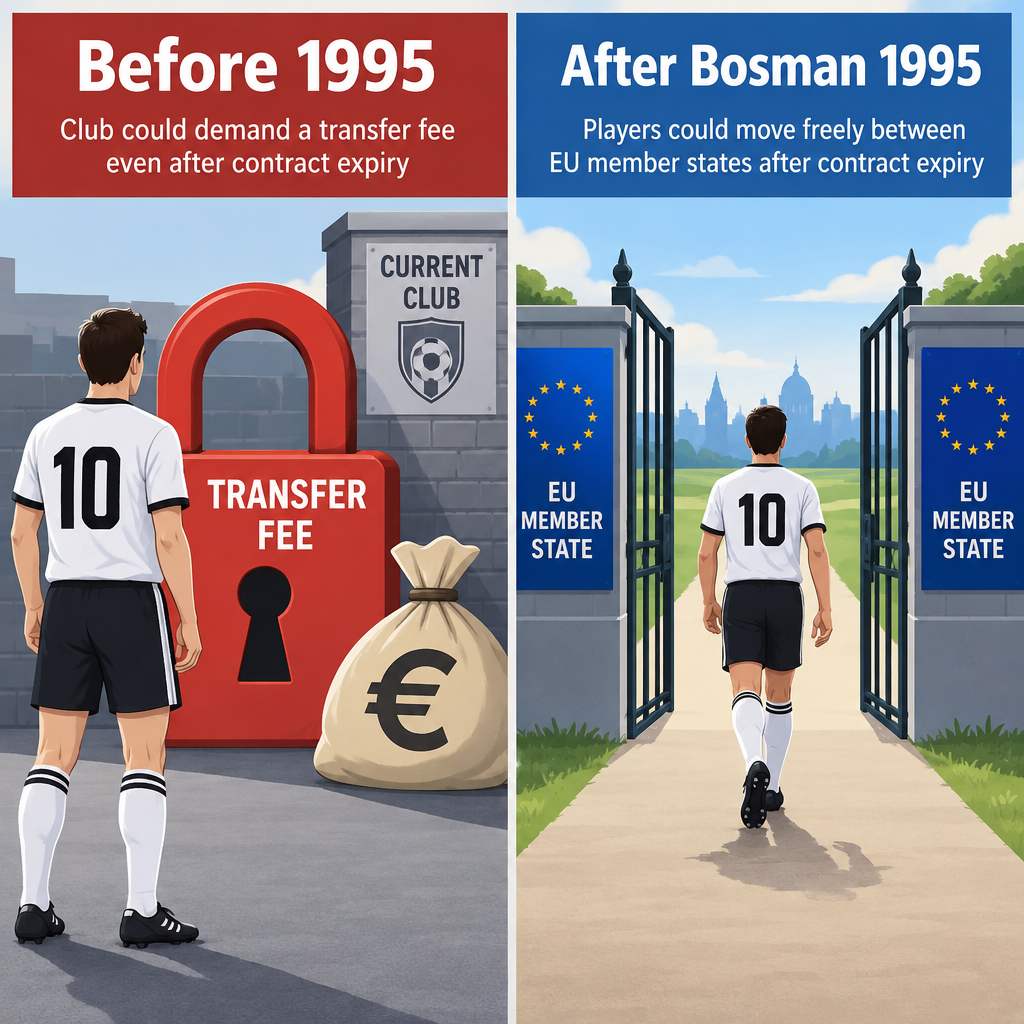
First, out-of-contract players became free to move abroad without a fee. Before 1995, a club could demand a “transfer, training or development fee” even after a player’s contract had expired. If the buying club refused to pay, the player could not be registered. The Court ruled that this breached Article 48 of the EC Treaty, the free movement of workers provision that now sits in Article 45 of the Treaty on the Functioning of the European Union (TFEU).
Second, quotas on EU nationals were outlawed. UEFA’s “3+2” rule allowed clubs in European competition to field only three foreign players, plus two “assimilated” foreigners who had played in that country for five uninterrupted years, three of them in youth teams. National leagues ran similar limits. The Court ruled these caps breached the same free movement principle whenever they counted players from other member states as foreigners.
In Spanish-speaking countries the judgment is widely called the “ley Bosman” (Bosman law), although it was never a statute passed by any parliament. It is case law: a court’s reading of EU treaty rules, binding on every member state. “Bosman law,” “Bosman ruling,” “Bosman case” and “Bosman rule” all point to the same 1995 decision.
Who was Jean-Marc Bosman?
Jean-Marc Bosman was a Belgian midfielder who began at Standard Liège and joined RFC Liège, then a Belgian first division club, in 1988. His contract ran until 30 June 1990. The facts of his dispute are set out in the Court’s judgment, and they explain why the case became so powerful: the system made it possible for a club to block an ordinary player’s career over a fee he had no part in negotiating.
According to the judgment, Bosman had been earning an average of 120,000 Belgian francs a month, including bonuses. In April 1990, RFC Liège offered him a new one-season deal at 30,000 francs a month, the minimum the Belgian federation’s rules allowed. He refused. The club placed him on the transfer list with a compensation fee of 11,743,000 Belgian francs, calculated under federation rules.
No Belgian club took him at that price. Bosman found his own move to US Dunkerque in the French second division, on roughly 100,000 francs a month plus a signing bonus of around 900,000 francs. On 27 July 1990 the two clubs agreed a one-year loan for 1,200,000 francs, with an option for Dunkerque to buy him outright for 4,800,000 francs.
The deal depended on the Belgian federation sending his transfer certificate to the French federation before the start of the French season on 2 August 1990. RFC Liège, doubting Dunkerque’s ability to pay, never asked for the certificate to be sent. On 31 July 1990 the club suspended Bosman, which kept him out for the whole season.
On 8 August 1990, Bosman sued RFC Liège in the Liège court of first instance. His lawyers were Jean-Louis Dupont and Luc Misson. The case grew over the next five years to include the Belgian federation and UEFA, and in October 1993 the Liège court of appeal referred questions to the European Court of Justice in Luxembourg.
What happened to Bosman afterwards
Winning a landmark case did nothing to rescue his career. He played on at lower levels in France, on Réunion and back in Belgium, but the years lost to litigation came at what should have been his peak. FIFPRO, the world players’ union, has long described him as a player who sacrificed his own career for the freedom of every footballer who came after him, and the union has supported him publicly. We are leaving his personal life out of this piece; the legal story is what matters here.
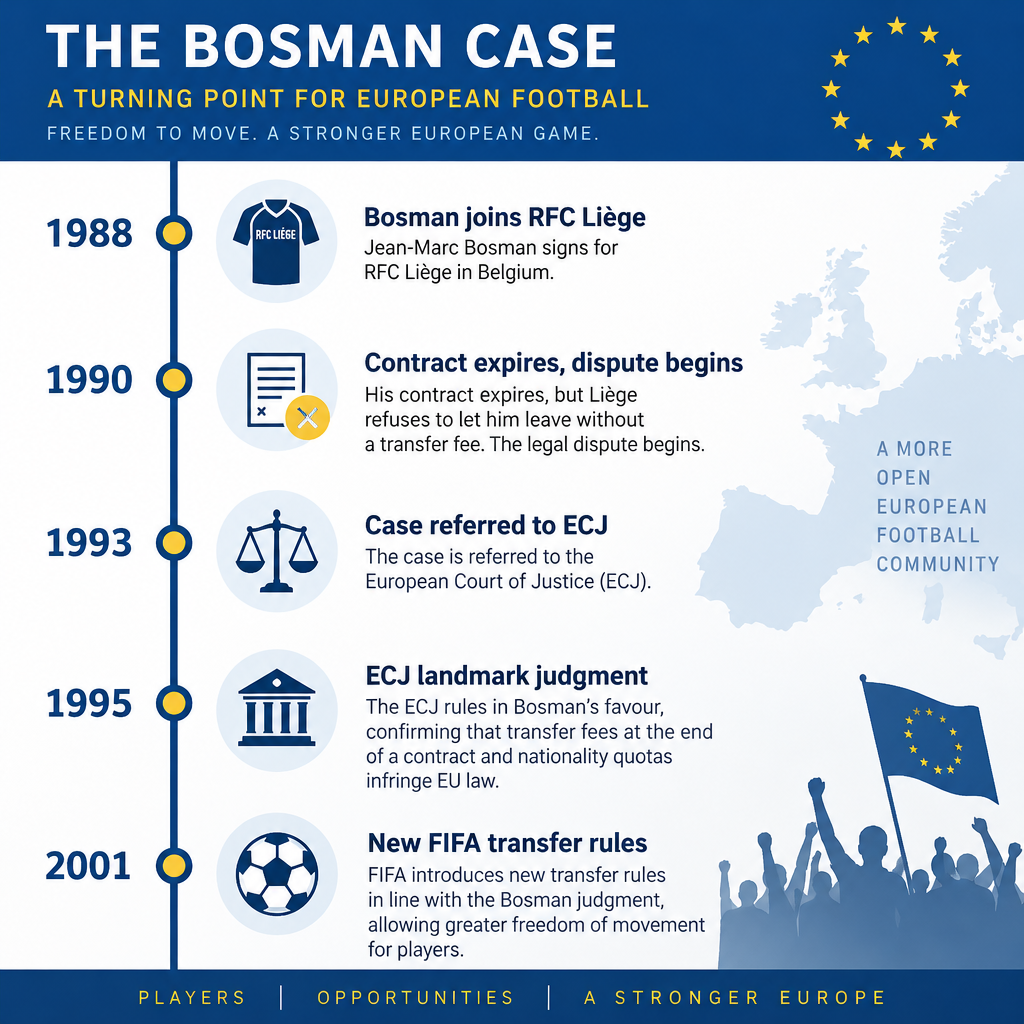
Bosman case timeline
| Date | Event |
|---|---|
| 1988 | Bosman joins RFC Liège on a contract ending 30 June 1990 |
| 21 April 1990 | Liège offers a one-year deal at the federation minimum wage |
| 27 July 1990 | Loan deal with US Dunkerque agreed, subject to transfer certificate |
| 31 July 1990 | Liège suspends Bosman after the certificate is not requested |
| 8 August 1990 | Bosman sues RFC Liège in Belgium |
| 1 October 1993 | Liège court of appeal refers the case to the ECJ |
| 20 September 1995 | Advocate General Carl Otto Lenz delivers his opinion |
| 15 December 1995 | ECJ judgment in Case C-415/93 |
| March 2001 | European Commission and FIFA settle on a new transfer system |
| 1 September 2001 | FIFA’s new transfer regulations take effect |
What the Court actually decided
The judgment is often summarised as “players can leave for free.” That is accurate as far as it goes, but the reasoning is what shaped everything that followed.
Football was an economic activity
The Court restated a principle from its earlier cases, Walrave and Koch (1974) and Donà v Mantero (1976): sport is subject to EU law insofar as it is an economic activity. Professional footballers are workers, paid wages under employment contracts, so free movement rules apply to them. Football bodies argued that their rules were private, sporting rules outside the treaty. The Court disagreed. Rules drawn up by private associations to regulate employment collectively must still respect free movement.
Transfer fees were a restriction on movement
The key step was finding that fees on out-of-contract players obstructed free movement even though they applied equally to domestic and cross-border moves. A player could not take a job in another member state unless a fee was paid that had nothing to do with him. That made the rule a barrier to access to the employment market.
The justifications failed the proportionality test
UEFA and the Belgian federation put forward two aims: maintaining a financial and competitive balance between clubs, and supporting the search for talent and training of young players. The Court accepted both as legitimate. It then asked whether the fee system was a suitable and proportionate way to achieve them, and found that it was not.
On competitive balance, the Court noted that the rules did not stop the richest clubs from buying the best players, so they did not actually prevent wealth from deciding outcomes. On training, the Court said fees were by nature uncertain and unrelated to the real cost of training, so they could not be justified as compensation for it. The Advocate General had gone further, suggesting that the same aims could be reached by other means, such as sharing collective revenue between clubs.
Quotas discriminated on nationality
The quota point was simpler. Rules capping the number of players from other member states were direct discrimination on grounds of nationality. The argument that national teams needed domestic clubs to field local players did not save them. The Court observed that players need not play for clubs in their own country to be selected for their national team.
What the Court did not decide
Because it had found a breach of free movement, the Court decided it did not need to rule on the competition law questions under what were then Articles 85 and 86 of the EC Treaty. It also limited the ruling’s retroactive effect. The direct effect of its finding on transfer fees could not be relied on to reclaim fees already paid or owed before the judgment date, except by people who had already started legal proceedings.
How to cite the Bosman ruling
For students and writers, the standard citation is Case C-415/93 Union royale belge des sociétés de football association ASBL v Jean-Marc Bosman [1995] ECR I-4921, with the identifier ECLI:EU:C:1995:463. The opinion of Advocate General Lenz is published alongside it and is worth reading for the alternatives he proposed.
Before and after Bosman: what changed
| Issue | Before 15 December 1995 | After Bosman |
|---|---|---|
| Out-of-contract EU player moving to another member state | Former club could demand a fee | No fee can be demanded |
| Limit on players from other EU states | UEFA 3+2 rule, national quotas | Unlawful for EU nationals |
| Limit on non-EU players | Permitted | Still permitted (subject to later cases) |
| Fees for players under contract | Negotiated between clubs | Still negotiated between clubs |
| Player bargaining power at contract end | Weak, club held his registration | Strong, he can walk away |
| Domestic moves within one country | National rules | National rules, most later aligned |
Common myth
Bosman does not let a player leave for free whenever he likes. The free move only applies once his contract has expired, and clubs still charge fees for players under contract.
How a Bosman transfer works today
The modern Bosman transfer runs on two layers: the free movement principle from the 1995 judgment, and FIFA’s Regulations on the Status and Transfer of Players (RSTP), which turned that principle into a global operating system. The RSTP were rewritten after the European Commission challenged FIFA’s transfer rules, and the new system took effect on 1 September 2001.
The most important line for a Bosman move is Article 18.3 of the RSTP. A club intending to sign a professional must inform his current club in writing before entering into negotiations with him. And a professional is only free to conclude a contract with another club if his contract has expired or is due to expire within six months.
How a Bosman transfer works
- The player’s contract enters its final six months.
- The interested club notifies his current club in writing.
- The player negotiates and signs a pre-contract agreement.
- His existing contract runs out on its end date.
- The new club registers him; no transfer fee is due.
For a standard European contract ending on 30 June, the six-month mark falls on 1 January. That is why so many “pre-contract signed” announcements appear in January and February, and why a player in the last year of his deal becomes a live transfer story from the moment the winter window opens.
What the player can do at each stage of his contract
| Time left on contract | Can sign with a club abroad? | Can the current club demand a fee? | Typical club response |
|---|---|---|---|
| More than 12 months | No | Yes, negotiated fee | Offer extension or sell at full value |
| 6 to 12 months | No (can be approached only after notice) | Yes, but leverage falls | Last realistic chance to sell for a fee |
| Under 6 months | Yes, pre-contract allowed | Yes, for an early release only | Accept a cut-price fee or let him go |
| Expired | Yes, free agent | No | None |
Registration outside the window
Free agents also get a scheduling advantage. FIFA’s rules allow a professional whose contract expired before the end of a registration period to be registered outside that period. National associations apply this through their own regulations, so the exact mechanics differ by league, but it is why out-of-contract players can sometimes join clubs after the window has shut.
Ref's note
The six-month rule is FIFA’s rule for moves between countries. Moves within one country follow that country’s own regulations, and some are stricter about when a rival domestic club may approach a player.
Fees that can still apply to a “free” transfer
A Bosman move is free of a transfer fee. That does not mean no money changes hands.
- Training compensation. Under FIFA’s rules, training compensation can be owed to the clubs that trained a player when he signs his first professional contract and on later international moves until the end of the season of his 23rd birthday. Within the EU/EEA there are special conditions: a former club that did not offer the player a contract generally loses its claim, unless it can justify why.
- Solidarity contribution. FIFA’s solidarity mechanism shares 5% of a transfer fee between clubs that trained the player between the ages of 12 and 23. With no fee, there is nothing to distribute, so free transfers starve that system.
- Domestic compensation in England. English football keeps a compensation scheme for out-of-contract players under 24 moving between English clubs, provided the old club offered terms at least as good as before. If the clubs cannot agree, the Professional Football Compensation Committee sets the figure.
- Signing bonuses and agent fees. Clubs that save on a fee typically spend part of it elsewhere. Large signing-on bonuses and agent commissions are standard features of high-profile free moves.
Is every free transfer a “Bosman”?
Strictly, no. The judgment covered cross-border moves between EU member states, so Sol Campbell’s move from Tottenham to Arsenal in 2001 or Robert Lewandowski’s switch from Borussia Dortmund to Bayern Munich in 2014 were domestic free transfers governed by national rules. In everyday football language, though, “going on a Bosman” means running down your contract and leaving for nothing, and we use the term in that broader sense too. Most European countries aligned their domestic rules with the principle after 1995, which is why the distinction rarely matters to fans.
Famous Bosman and free transfers
| Player | From | To | Year | Note |
|---|---|---|---|---|
| Edgar Davids | Ajax | AC Milan | 1996 | Early sign of Ajax’s 1995 team breaking up |
| Steve McManaman | Liverpool | Real Madrid | 1999 | First major British cross-border Bosman |
| Sol Campbell | Tottenham | Arsenal | 2001 | Domestic free move between rivals |
| Michael Ballack | Bayern Munich | Chelsea | 2006 | Germany captain moved for no fee |
| Andrea Pirlo | AC Milan | Juventus | 2011 | Domestic move that reshaped Serie A |
| Robert Lewandowski | Borussia Dortmund | Bayern Munich | 2014 | Domestic, signed months before his deal expired |
| Lionel Messi | Barcelona | Paris Saint-Germain | 2021 | Contract expired 30 June 2021 |
| Gianluigi Donnarumma | AC Milan | Paris Saint-Germain | 2021 | Goalkeeper ran down his Milan deal |
| Kylian Mbappé | Paris Saint-Germain | Real Madrid | 2024 | Contract expired 30 June 2024 |
Ajax illustrates the “bounty of the big clubs” argument well. The club won the Champions League in 1995 with a squad built largely from its own academy. Within a few years players such as Davids and Michael Reiziger had moved to Milan without Ajax receiving the fees that its youth system would once have guaranteed. A model built on producing and selling talent lost one of its two revenue streams.
Bosman and quotas: what happened to foreign player limits
The quota half of the ruling gets less attention, yet it changed the look of European squads just as dramatically. Within a few seasons, clubs could field entire starting line-ups of players from other EU states. Chelsea became the first English top-flight club to field an entirely foreign starting XI, against Southampton on 26 December 1999.
The ruling did not, however, outlaw every limit on foreign players. It applied to nationals of EU member states (later extended to the wider European Economic Area, with Switzerland covered through a separate agreement). Limits on players from outside those countries remained lawful in principle, and many leagues still use them. LaLiga, for example, lets each club register a maximum of three non-EU players.
Later cases pushed the boundary further:
- Kolpak (2003). Maros Kolpak, a Slovak handball goalkeeper in Germany, won the right to be treated equally because Slovakia, then outside the EU, had an association agreement with the EU. Players from countries with such agreements could no longer be counted as “foreigners” for quota purposes.
- Simutenkov (2005). Igor Simutenkov, a Russian forward at Tenerife, relied on the EU’s partnership agreement with Russia to challenge Spain’s non-EU limits in a similar way.
Homegrown rules: quotas by another name?
UEFA’s answer to post-Bosman squads was the homegrown player rule, phased in from 2006/07. In UEFA club competitions, a 25-player A list must include eight “locally trained” players, of whom at least four must be “club-trained” (trained at the club for three seasons between ages 15 and 21). Nationality is irrelevant; training location is what counts. The Premier League adopted its own version from 2010/11, capping squads at 17 players who are not homegrown.
That design was meant to stay on the right side of Bosman. In December 2023, the Court of Justice cast doubt on it. In the Royal Antwerp case (C-680/21, judgment of 21 December 2023), the Court said UEFA’s and the Belgian federation’s homegrown rules could amount to indirect discrimination and a restriction of competition, and left the national court to decide whether they were justified and proportionate. As of our latest research, homegrown rules remain in force, but their legal footing is less secure than it was.
Bosman and transfer fees: the money effect
A common assumption is that Bosman killed transfer fees. The opposite happened. Fees for players under contract were untouched, and they rose sharply in the years after 1995 as television money flooded into the top leagues. What changed was where the value sat.
Before Bosman, a club owned a player’s registration even after his contract expired. That gave the club an asset it could sell regardless of the player’s wishes. After Bosman, the asset had an expiry date. Clubs responded by doing three things.
Longer contracts. Clubs began tying players to longer deals to protect resale value. FIFA’s rules today cap professional contracts at five years (three years for players under 18), which sets the outer limit on that strategy.
Selling a year early. Clubs learned that a player with 12 months left is worth far less than one with three years left, and one with six months left is worth almost nothing. Selling while there is still a contract to sell became standard practice.
Extensions as asset protection. Contract renewals became financial transactions as much as sporting ones. A two-year extension with a pay rise is often cheaper than losing a player for nothing.
Wage inflation: where the savings went
The transfer fee a club no longer pays for a free agent does not disappear. Players and agents know the buying club has saved money, and they negotiate a share of it through higher wages and signing bonuses. Economists and club executives broadly agree that Bosman shifted bargaining power toward players, and that wages took a larger share of club income over the following decades.
That pressure is the background to today’s financial rules. UEFA’s squad cost ratio limits spending on wages, transfers and agent fees to a share of revenue: 90% in 2023/24, 80% in 2024/25 and 70% from 2025/26. In England, Premier League clubs agreed in late 2025 to replace Profitability and Sustainability Rules (PSR) with a squad cost ratio model from 2026/27. Thirty years after Bosman freed player movement, regulators are building cost controls around the consequences.
The 2001 settlement: how FIFA rebuilt the transfer system
Bosman dealt with out-of-contract players. It left open whether clubs could enforce contracts with players still under contract, and whether the international transfer system as a whole complied with EU law. The European Commission opened proceedings against FIFA’s rules, and in March 2001 the Commission and FIFA reached a settlement on a new system. FIFA’s revised regulations came into effect on 1 September 2001.
The 2001 framework is the backbone of the system we see today:
- Training compensation for clubs that develop young players, linked to training costs, up to age 23.
- The solidarity mechanism, sharing 5% of transfer fees with youth clubs.
- Transfer windows, generally one in summer and one in mid-season.
- Protected periods: three seasons or three years for contracts signed before a player’s 28th birthday, two years after it, during which breaching a contract can bring sporting sanctions.
- Protection of minors, with international transfers of under-18s banned except in defined cases, including moves within the EU/EEA between ages 16 and 18 under strict conditions.
Article 17 of the RSTP set out what happens when a contract is broken without just cause: the party in breach pays compensation, and in the protected period, sporting sanctions can follow. That article later produced its own landmark disputes at the Court of Arbitration for Sport, including the Webster and Matuzalem cases, before the Court of Justice took a fresh look at it in 2024.
The sporting exception and the “specificity of sport”
Football’s governing bodies argued in Bosman that sport deserved an exemption from ordinary economic law. The Court rejected a blanket exception but recognised that sport has particular features. That tension has run through every case since.
The EU’s political institutions softened the edges. A declaration on sport annexed to the 1997 Treaty of Amsterdam emphasised its social significance, and the Nice declaration of 2000 went further on its specific characteristics. The Lisbon Treaty, in force from December 2009, gave sport a treaty basis in Article 165 TFEU, which tells the EU to take account of “the specific nature of sport.”
The Court’s case law has since clarified what that means in practice:
| Case | Year | What it decided |
|---|---|---|
| Walrave and Koch | 1974 | Sport is subject to EU law when it is an economic activity |
| Donà v Mantero | 1976 | Nationality rules for professionals breach free movement, except for purely sporting matches |
| Bosman (C-415/93) | 1995 | Fees for out-of-contract players and EU quotas are unlawful |
| Lehtonen (C-176/96) | 2000 | Transfer deadlines in Belgian basketball can be justified |
| Kolpak (C-438/00) | 2003 | Association agreement nationals cannot face quota discrimination |
| Meca-Medina (C-519/04 P) | 2006 | Sporting rules are not automatically exempt from competition law |
| Bernard (C-325/08) | 2010 | Training compensation is lawful if tied to actual training costs |
| Royal Antwerp (C-680/21) | 2023 | Homegrown rules must be justified and proportionate |
| European Superleague (C-333/21) | 2023 | FIFA and UEFA approval rules for new competitions breached competition law |
| Diarra (C-650/22) | 2024 | Parts of FIFA’s contract breach compensation rules breach EU law |
The Bernard case is the natural sequel to Bosman. Olivier Bernard, a Lyon academy product, refused Lyon’s offer of a professional contract and joined Newcastle in 1997. Lyon sued for damages under French rules. The Court held that a scheme compensating training clubs can be justified, but only if it relates to the actual costs of training. A rule demanding damages unrelated to those costs went too far.
Proportionality and the hidden judicial regulator
Legal scholars have long pointed out that proportionality, the tool the Court used in Bosman, quietly turns judges into regulators. Once a court accepts that an aim is legitimate, it must decide whether a given rule is suitable and whether a less restrictive alternative exists. In football, that means judges assess transfer systems, quota schemes and competition formats, questions that governing bodies would normally settle through their own decision-making bodies.
The academic critique draws on the work of the American legal philosopher Lon Fuller, whose essay “The Forms and Limits of Adjudication” argued that courts handle “polycentric” problems badly. A polycentric problem is one where every decision ripples across many interconnected interests. Football’s labour market is a textbook example: changing one rule shifts wages, academy funding, competitive balance, national team selection and club finances at the same time.
Bosman came to court as one player’s dispute with one club over one blocked loan. The judgment rewrote the employment terms of every professional footballer in the EU. Critics describe this as the vice of simplification: a court resolves the narrow question in front of it, and the industry must then live with consequences no party argued about in detail. Supporters reply that the governing bodies had decades to reform a system that let a club suspend a player for a full season over an unpaid certificate, and did nothing until a court forced them.
We think both sides have a point, but the second carries more weight. The Court did not invent the problem. It refused to let private rule-makers keep a restriction they could not justify, and it left the design of alternatives to the sport itself. The 2001 settlement shows that football could build a workable system once it had to.
Social dialogue: the cure for polycentric problems?
If courts are poor at designing complex systems, the obvious alternative is negotiation between the people affected. That is the logic behind the European Social Dialogue Committee for professional football, established in 2008 with representatives of players (FIFPRO Europe), clubs (the European Club Association), leagues (now European Leagues) and UEFA. In 2012 the partners signed an agreement on minimum requirements for player contracts across Europe.
Social dialogue cannot override EU law, and it has not stopped litigation, as the Diarra and Royal Antwerp cases show. But collectively agreed rules carry more legitimacy than rules imposed from above, and courts tend to look more kindly on restrictions negotiated with player representatives. The Diarra aftermath is testing this again, with FIFA consulting stakeholders as it rewrites its regulations.
After Bosman: the Diarra ruling and the next frontier
On 4 October 2024, the Court of Justice ruled in the case of Lassana Diarra, the former France midfielder. Lokomotiv Moscow terminated his contract in 2014, and FIFA’s Dispute Resolution Chamber ordered him to pay the club €10.5 million. A move to Belgian club Charleroi collapsed because, under FIFA’s rules, a new club could be held jointly liable for that compensation, and the player’s international transfer certificate could be withheld.
The Court found that these rules were liable to breach both EU free movement and competition law, because they made it far riskier for any club to sign a player who had left his previous club in disputed circumstances. In December 2024, FIFA adopted an interim regulatory framework amending the relevant parts of the RSTP while it worked on longer-term changes.
Many commentators have labelled Diarra “the new Bosman.” The comparison is fair in one respect: both cases strike at mechanisms that tied players to clubs beyond what employment law would normally allow. The difference is scope. Bosman freed players at the end of their contracts. Diarra concerns what happens when a contract is ended early. How far it reshapes the market depends on how FIFA’s permanent rules develop and how national courts apply the judgment, and that process was still unfolding at the time of our latest research.
Bosman after Brexit
The United Kingdom left the EU single market on 1 January 2021, and EU free movement no longer applies to moves between British and EU clubs. That has three practical consequences.
- Work permits. EU players joining English clubs now need a Governing Body Endorsement under a points-based system, just like players from elsewhere in the world.
- Under-18 signings. British clubs lost access to FIFA’s EU/EEA exception for international transfers of 16- and 17-year-olds.
- Free moves continue anyway. The free-agent principle lives on through FIFA’s global rules. A player whose contract with a Spanish club expires can still join an English club without a fee, and the six-month pre-contract rule still applies to international moves.
In other words, Brexit changed the legal basis and the immigration paperwork, not the core economics of an out-of-contract move.
Why Bosman still matters today
Thirty years on, the Bosman rule is embedded in almost every transfer story we read. The pre-contract saga, the January tug-of-war over a player in his final six months, the club selling a star with a year left, the free agent who lands a huge signing bonus: all of it traces back to a December 1995 judgment about a midfielder in Belgium’s top flight who wanted to play in France’s second tier.
Its deeper legacy is the principle that football’s private rule-makers answer to the same law as everyone else when they regulate people’s jobs. Every major legal fight in the modern game, from homegrown quotas to the Superleague to Diarra, starts from the ground Bosman cleared. Players today hold power over their futures that their predecessors simply did not have, and the game’s financial rules are still catching up with that shift.
FAQ
What is the Bosman rule in simple terms?
It is the principle that a footballer whose contract has expired can join a club in another EU country without that club paying a transfer fee. The same 1995 European Court of Justice ruling also banned quotas limiting how many players from other EU countries a club could field.
When can a player sign a pre-contract under the Bosman rule?
Under Article 18.3 of FIFA’s transfer regulations, a player can sign with a club in another country once his contract has six months or less to run. The new club must first inform his current club in writing. For a contract ending 30 June, that means from 1 January.
Is a Bosman transfer the same as a free transfer?
In common usage, yes. Strictly speaking, the Bosman ruling covered moves between EU member states, while domestic free transfers are governed by national rules. Most European countries brought their domestic rules into line after 1995, so fans use the terms interchangeably.
Does the Bosman rule still apply in England after Brexit?
EU free movement no longer covers moves between the UK and the EU, and EU players now need work permits. Free transfers at the end of a contract still happen, though, because FIFA’s global regulations preserve the free-agent principle for international moves.
Can a club demand any money for an out-of-contract player?
Not a transfer fee. Training compensation may still be due for younger players under FIFA rules, generally up to the season of their 23rd birthday, and English football keeps a domestic compensation scheme for out-of-contract players under 24 moving between English clubs.
What does “ley Bosman” mean?
It is the Spanish term for the Bosman ruling, literally “Bosman law.” It refers to the same 1995 European Court of Justice judgment rather than a law passed by any parliament.
Did the Bosman ruling ban all foreign player limits?
No. It banned limits on nationals of EU member states, later extended to the wider European Economic Area and Switzerland. Leagues can still restrict players from outside those countries, as LaLiga does with its three non-EU registration slots, although later cases such as Kolpak narrowed that room further.