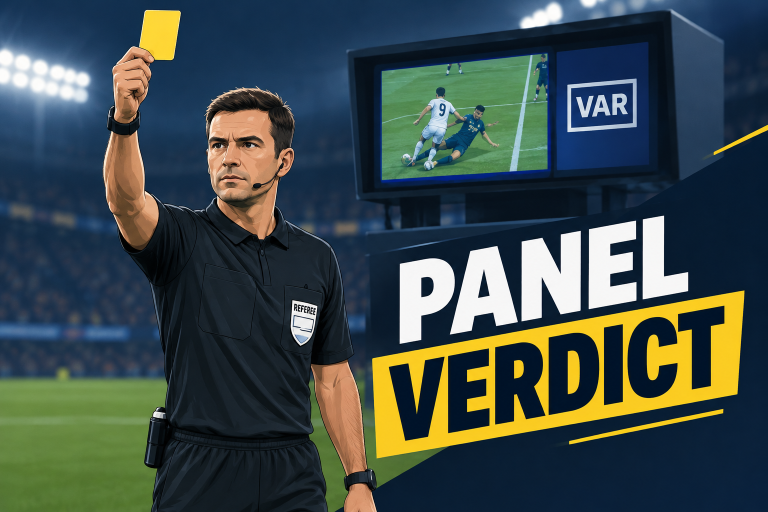
VAR stands for Video Assistant Referee. It’s a match official who watches replays on a bank of screens and helps the on-field referee fix clear and obvious errors in four game-changing situations: goals, penalties, direct red cards and mistaken identity. The referee on the pitch always makes the final decision.
What does VAR mean in soccer?
In football, VAR refers to two things. First, it’s a person: a qualified referee working away from the pitch, usually in a video operation room. Second, people use it as shorthand for the whole video review system: the officials, the camera feeds and the protocol they follow.
I hear it pronounced both ways. Some fans spell it out as “V-A-R,” and others say it as one word that rhymes with “car.” Both are fine, and both mean the same thing.
The International Football Association Board (IFAB), which writes the Laws of the Game, approved VAR into the Laws at its annual meeting in March 2018. The 2018 World Cup in Russia was the first World Cup to use it. Today, Law 6 lists the VAR and the assistant VAR among the “other match officials,” and a dedicated VAR protocol section of the Laws sets out exactly when and how they can step in.
The core idea: minimum interference, maximum benefit
People often misunderstand this part. VAR exists to correct clear and obvious errors or serious missed incidents. Re-refereeing every close call is not its job.
If a decision is a matter of opinion and the referee’s call was reasonable, VAR is supposed to leave it alone. That is why you’ll see contact in the box that looks like a foul to you, while VAR stays silent. The question VAR asks isn’t “would I have given that?” It asks whether the referee’s decision was clearly wrong.
Common myth
“VAR overrules the referee.” It can’t. VAR only advises. The on-field referee decides, either by accepting the VAR’s information or by watching the replay at the pitchside monitor.
What VAR can and can’t review
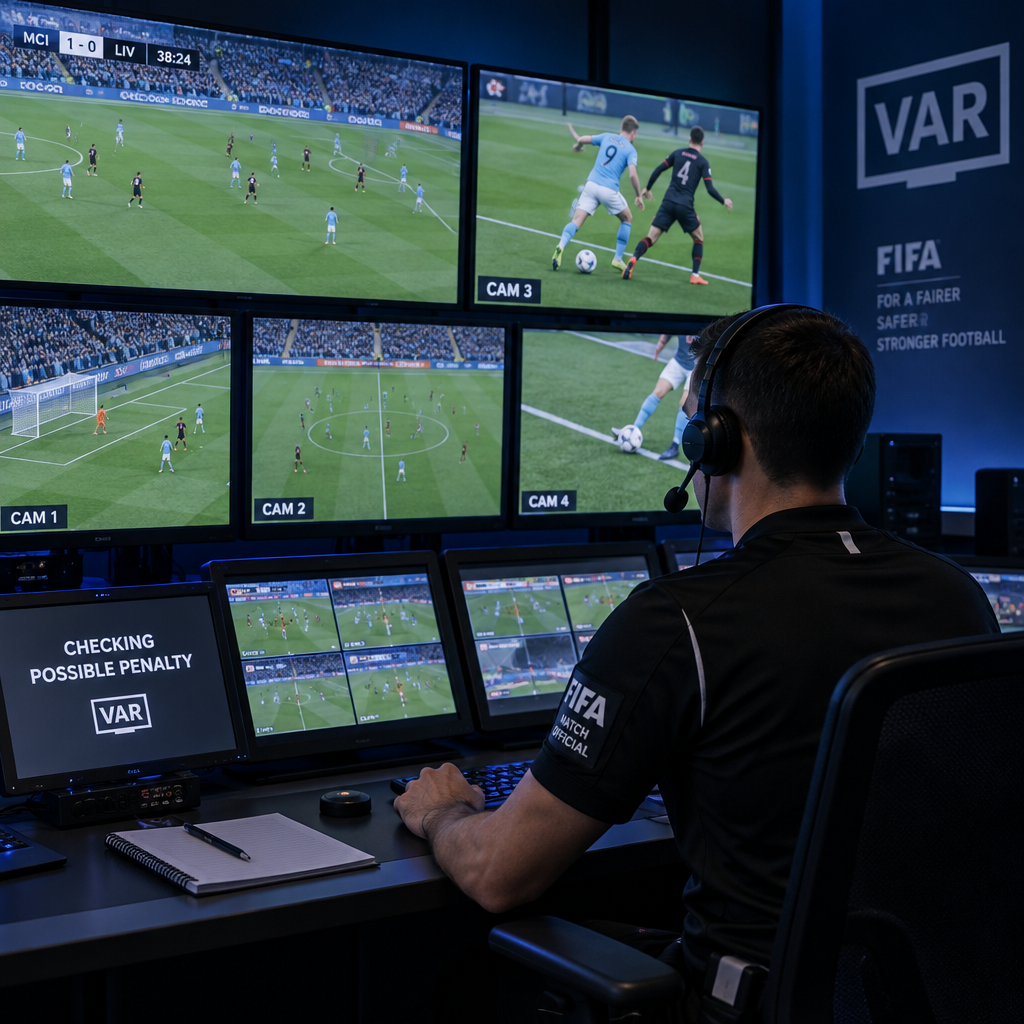
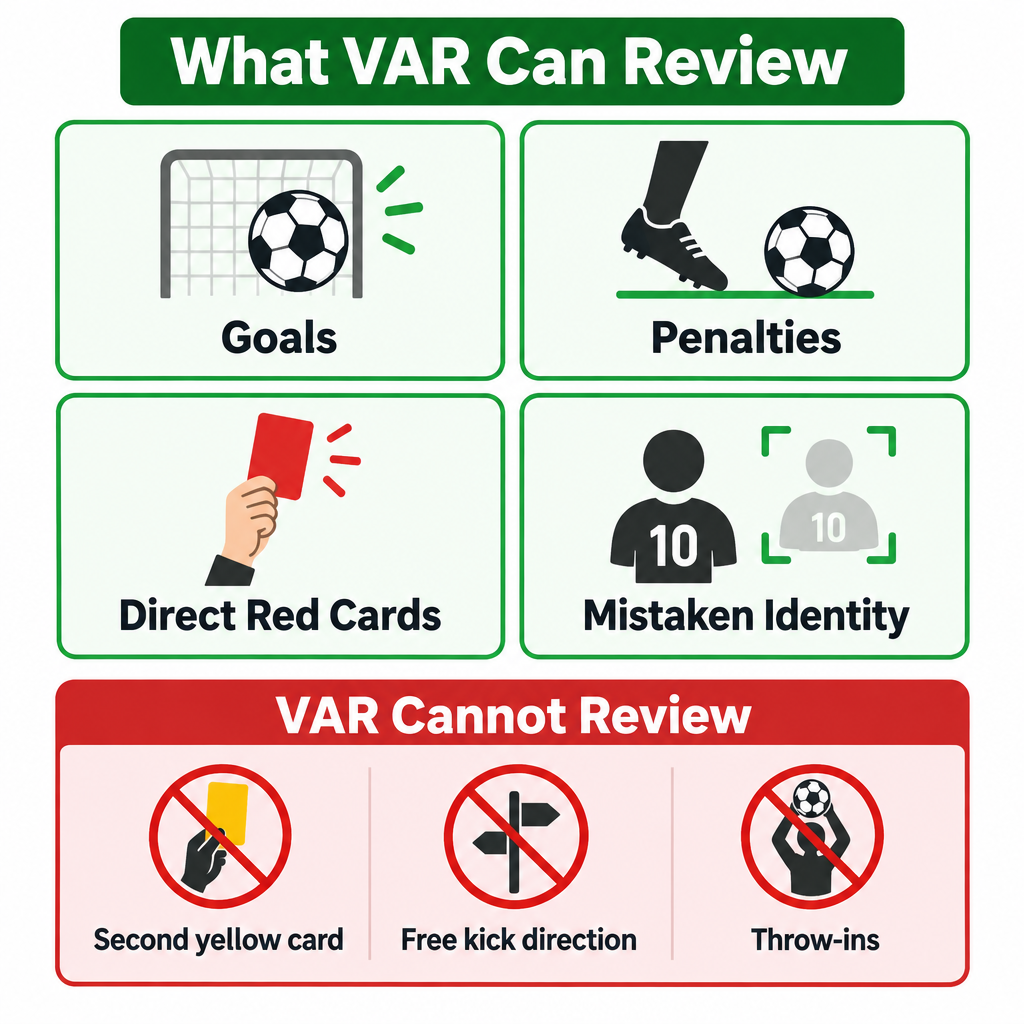
The protocol limits VAR to four categories. Everything else stays with the on-field team.
| Situation | Can VAR intervene? | Why |
|---|---|---|
| Goal or no goal (offside, foul or handball in the build-up, ball out of play) | Yes | Goals are a match-changing decision |
| Penalty or no penalty | Yes | Listed category in the protocol |
| Direct red card | Yes | Covers serious foul play, violent conduct, denying an obvious goal-scoring opportunity |
| Mistaken identity (wrong player booked or sent off) | Yes | Listed category in the protocol |
| Second yellow card | No, under the protocol as I know it | Second cautions sit outside the four categories |
| Free kick or corner awarded the wrong way | No, under the protocol as I know it | Not a match-changing category |
| Throw-in direction | No | Not a match-changing category |
IFAB had discussed letting VAR look at second yellow cards and wrongly awarded corners going into 2026. I haven’t been able to confirm whether those changes are in force in every competition, so check the current edition of the Laws before relying on those two rows.
How a VAR review works, step by step
Every incident in those four categories is checked silently in the background. Only a small share turn into a full review.
How a VAR decision happens
- The VAR checks every goal, penalty, red card and identity incident automatically.
- If there’s a possible clear error, the VAR tells the referee through their headset.
- The referee can pause play or delay the restart.
- For facts (offside position, ball out of play), the referee usually accepts the VAR’s information.
- For judgment calls (foul severity, handball), the referee goes to the pitchside monitor.
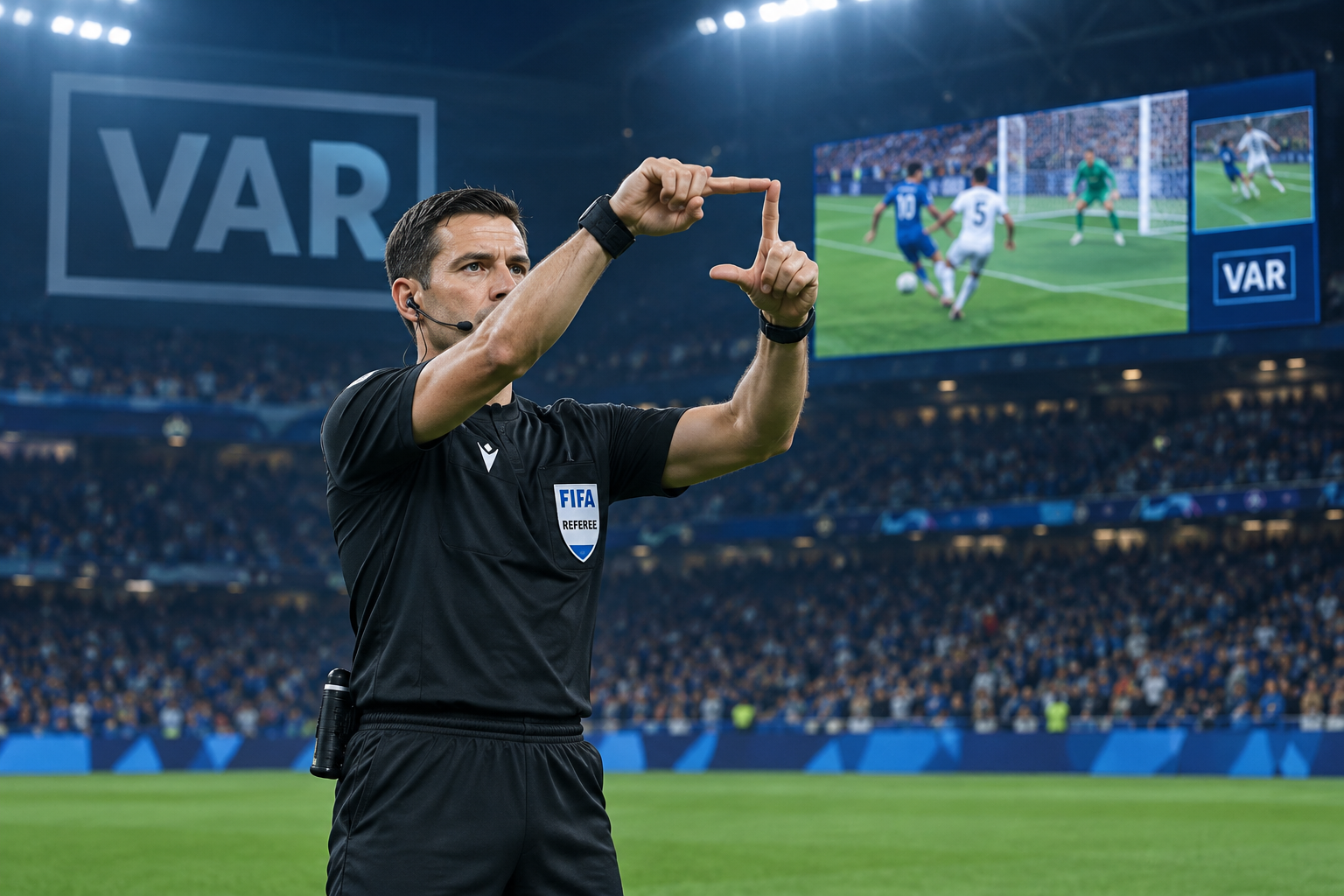
- The referee draws a rectangle in the air, then gives the final decision.
That rectangle signal is the TV screen gesture you’ll see at every elite match. A trip to the monitor is called an on-field review.
Ref's note
VAR can only go back as far as the start of the “attacking phase of play” for goals and penalties. A foul 90 seconds earlier in a different passage of play can’t be used to cancel a goal.
VAR glossary: the terms you’ll hear on broadcasts
The ranking glossaries pad this out a lot. These are the terms that matter.
| Term | Meaning |
|---|---|
| VAR | Video Assistant Referee, the lead video official |
| AVAR | Assistant VAR, who watches live play while the VAR studies replays |
| RO | Replay operator, a technician who finds and cues up camera angles |
| VOR | Video operation room, where the video team works |
| OFR | On-field review, when the referee watches the monitor |
| RRA | Referee review area, the pitchside spot with the monitor |
| APP | Attacking phase of play, the window VAR can look back over |
| SAOT | Semi-automated offside technology |
| Check vs review | A check is silent; a review means the decision is being reconsidered |
Goal-line technology is a separate system, by the way. It tells the referee within seconds whether the whole of the “soccer ball” crossed the goal line, and it works independently of the VAR team.
When VAR arrived around the world
The first live trial of VAR took place in the United States, in a USL match between New York Red Bulls II and Orlando City B in August 2016. Adoption spread quickly from there.
| Competition | First used VAR |
|---|---|
| USL (live trial) | August 2016 |
| FIFA Club World Cup | December 2016 |
| MLS | August 2017 |
| Bundesliga and Serie A | 2017-18 season |
| FIFA World Cup | 2018 (Russia) |
| La Liga | 2018-19 season |
| UEFA Champions League | 2018-19 knockout rounds |
| Premier League | 2019-20 season |
Semi-automated offside technology came later. While VAR itself debuted at the 2018 World Cup in Russia and reached the Premier League in the 2019/20 season, semi-automated offside technology was used at the 2022 World Cup in Qatar, and the Premier League introduced it on 12 April 2025.
Famous VAR moments
The first World Cup VAR penalty. France against Australia on June 16, 2018. The referee went to the monitor and awarded a penalty, and Antoine Griezmann scored it.
The 2018 World Cup final. Ivan Perišić handled in the box, the referee reviewed it on the monitor and pointed to the spot. Griezmann converted again, and France beat Croatia 4-2.
Luis Díaz at Tottenham, September 2023. Liverpool’s goal was wrongly ruled out for offside. The VAR team believed the on-field decision had been a goal, so they didn’t intervene. PGMOL, the body that runs Premier League refereeing, called it a “significant human error.” That incident showed me the system’s weak point is communication, not cameras.
The vote to keep it. In June 2024, Wolves proposed scrapping VAR in the Premier League. The other clubs voted to keep it, though they agreed it needed improving.
VAR in other acronyms and abbreviations
If you landed here from a non-football search, VAR means different things elsewhere:
| Field | VAR stands for |
|---|---|
| Football/soccer | Video Assistant Referee |
| Finance | Value at Risk |
| Business/IT sales | Value-Added Reseller |
| Statistics/economics | Vector Autoregression |
| Programming | “var,” a keyword for declaring a variable |
In any sports context, though, VAR means the video referee.
My take
VAR does what it was designed for. It catches the howlers: offside goals by a clear yard, penalties for dives with no contact, red cards shown to the wrong player. The frustration comes from fans expecting it to settle every subjective debate, which the protocol deliberately avoids. Judge it by the “clear and obvious” standard and it makes far more sense.
FAQ
What does VAR stand for?
Video Assistant Referee. In football and soccer it refers to the video official and, more loosely, to the whole video review system.
What is the VAR definition in the Laws of the Game?
The Laws treat the VAR as a match official who assists the referee using replay footage, and only for clear and obvious errors or serious missed incidents involving goals, penalties, direct red cards and mistaken identity.
Can VAR make a decision without the referee?
No. VAR only advises. The on-field referee makes every final decision.
Why do some reviews take so long?
Subjective calls need multiple angles, and offside checks without semi-automated technology require lines to be drawn manually. SAOT has cut that time in competitions that use it.
Does every league use VAR?
No. It requires broadcast-level camera coverage and trained video officials, so many lower leagues and smaller competitions still play without it.