Real Madrid is a Spanish football club from the capital, founded in 1902, that plays at the Estadio Santiago Bernabéu. It has won a record 15 European Cups and more Spanish league titles than any other club. Below we cover the club’s history, its stadium, its honours, the players who define it, and the rules and money that shape how it works.
Real Madrid in brief
Real Madrid Club de Fútbol is the most successful club in European competition. It is also one of the richest clubs in the world. It plays in LaLiga, the top tier of Spanish football. Its main rivals are Barcelona and city neighbours Atlético Madrid.
The club is owned by its members, the socios. No billionaire or investment fund owns it. Members elect the president, and Florentino Pérez has held the job since 2009, after a first spell from 2000 to 2006.
A few facts every fan should know:
- Nicknames: Los Blancos (the Whites) and Los Merengues (the Meringues), both after the all-white kit.
- Kit: White shirts, white shorts and white socks have been the club’s look since its early years. The usual story is that the founders copied Corinthian, the famous amateur club from London.
- Crest: The crown on the badge arrived in 1920, when King Alfonso XIII granted the royal title.
- Anthem: “Hala Madrid y nada más” was recorded in 2014 for the tenth European Cup, La Décima.
- Training ground: Ciudad Real Madrid at Valdebebas, on the northeast edge of the city, opened in 2005.
Common myth
“Real” does not mean “real” or “genuine”. It is Spanish for “royal”, a title granted by King Alfonso XIII in 1920.
Ref's note
Leeds United did not inspire Madrid’s white kit. It worked the other way: Don Revie switched Leeds to all white in the 1960s because he wanted his team to look like Real Madrid.
Real Madrid history: from Madrid FC to 15 European Cups
1902 to 1943: the founding years
The club began on 6 March 1902 as Madrid Football Club. Two Catalan brothers, Juan and Carlos Padrós, were among the founders, and Juan became the first president. The early side quickly became a force in the Copa del Rey. It won the competition four years running, from 1905 to 1908.
The royal title came in 1920, and the club became Real Madrid. When the Spanish league started in 1929, Barcelona took the first title. Madrid won its first league crown in 1931-32 and retained it the next season.
The Second Republic stripped royal symbols from public life in 1931. The club became plain Madrid FC again and lost its crown badge. The “Real” was restored in 1941. The Spanish Civil War had left the old Chamartín ground badly damaged. The club needed rebuilding, and in 1943 it found the man to do it.
The Bernabéu era and five straight European Cups
Santiago Bernabéu was a former player who became president in 1943. He held the post until his death in 1978. His vision shaped everything that followed. He borrowed money to build a huge new stadium, which opened in December 1947, and then went after the best players in the world.
The key signing was Alfredo Di Stéfano in 1953. Barcelona also claimed the Argentine forward, and the dispute was messy and political. Madrid won it, and the outcome still feeds the rivalry today.
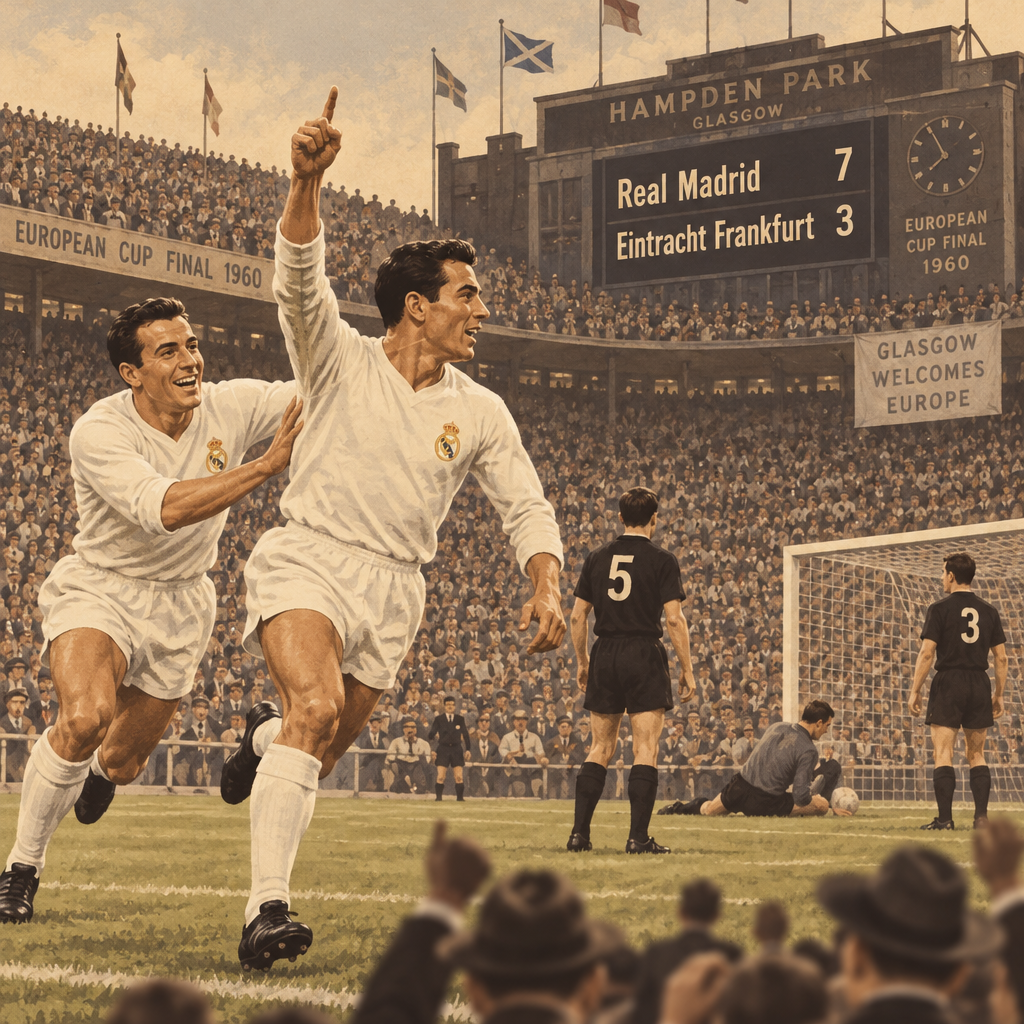
Di Stéfano changed the club. Real Madrid won the first five editions of the European Cup, from 1956 to 1960. Raymond Kopa, Francisco Gento and later Ferenc Puskás joined him. The 1960 final at Hampden Park in Glasgow is still the benchmark. Madrid beat Eintracht Frankfurt 7-3, with four goals from Puskás and three from Di Stéfano.
Domestic dominance followed. Under coach Miguel Muñoz, a player in the first two European Cup wins, Madrid won five straight league titles from 1960-61 to 1964-65.
Ye-yé, the Quinta del Buitre and the long wait
The sixth European Cup came in 1966 with a homegrown, all-Spanish side nicknamed the “Ye-yé” team, a nod to the Beatles era. Madrid beat Partizan Belgrade 2-1 in Brussels. Gento, the only survivor from the 1950s, collected his sixth winner’s medal.
Then came a 32-year wait for the next European Cup. Madrid stayed strong in Spain throughout. The 1980s brought the Quinta del Buitre (“the Vulture’s Cohort”), named after striker Emilio Butragueño, “El Buitre”. He came through the academy with Míchel, Manolo Sanchís, Martín Vázquez and Miguel Pardeza.
That group, with Mexican striker Hugo Sánchez, won two UEFA Cups (1985 and 1986). It also won five straight league titles from 1985-86 to 1989-90. The 1989-90 side scored 107 league goals, and Sánchez got 38 of them.
The European drought ended in Amsterdam in 1998. Predrag Mijatović scored the only goal against Juventus for La Séptima, the seventh title.
The Galácticos
Florentino Pérez won the presidency in 2000. He promised to sign Luís Figo from Barcelona, and he did it by paying the release clause. The move made Figo a villain in Catalonia for life.
Each summer brought a new superstar:
- Zinedine Zidane from Juventus in 2001, then a world-record fee
- Ronaldo Nazário from Inter in 2002
- David Beckham from Manchester United in 2003
The trophies came early. Madrid beat Valencia 3-0 in the 2000 final in Paris. In 2002 at Hampden Park, Zidane’s left-foot volley beat Bayer Leverkusen 2-1 for La Novena. It may be the most famous goal in club history.
The model then stalled. The squad was top-heavy, the defence was thin, and Madrid went three seasons without a trophy. Pérez resigned in February 2006.
Pérez’s second era: Cristiano, La Décima and three in a row
Pérez returned in 2009 and spent heavily again. Cristiano Ronaldo, Kaká and Karim Benzema all arrived that summer. José Mourinho’s side won the 2011-12 league with 100 points and 121 goals, both records at the time.
The obsession was the tenth European Cup. It came in Lisbon in 2014 against Atlético Madrid. Atlético led until Sergio Ramos headed in a corner at 92 minutes and 48 seconds. Madrid won 4-1 after extra time, under Carlo Ancelotti.
Zidane took over as coach midway through 2015-16 and did something no one had managed in the Champions League era. He won three in a row:
- 2016: beat Atlético again, on penalties in Milan
- 2017: beat Juventus 4-1 in Cardiff
- 2018: beat Liverpool 3-1 in Kyiv, with Gareth Bale’s overhead kick
Cristiano Ronaldo left for Juventus that summer as the club’s all-time top scorer.
2022, 2024 and the Mbappé years
Ancelotti came back in 2021. The 2021-22 Champions League run was built on late comebacks. Madrid knocked out Paris Saint-Germain, Chelsea and Manchester City. Against City, Rodrygo scored twice in stoppage time to force extra time. Vinícius Júnior then scored the only goal of the final against Liverpool in Paris.
In 2024 Madrid beat Borussia Dortmund 2-0 at Wembley, with goals from Dani Carvajal and Vinícius. That gave the club its 15th European Cup. It also made Ancelotti the first coach to win five. Carvajal, Luka Modrić, Toni Kroos and Nacho each reached six winner’s medals, level with Gento.
Kroos retired that summer. Kylian Mbappé arrived from PSG on a free transfer. His first season brought 31 LaLiga goals, the Pichichi trophy and the European Golden Shoe. The team, though, lost the league, the Copa del Rey final and the Supercopa to Barcelona. Arsenal knocked Madrid out of the Champions League quarter-finals 5-1 on aggregate.
Ancelotti left in 2025 to coach Brazil. Xabi Alonso, a Champions League winner as a Madrid player in 2014, took charge that summer. His first matches came at the Club World Cup in the United States.
Real Madrid European Cup finals
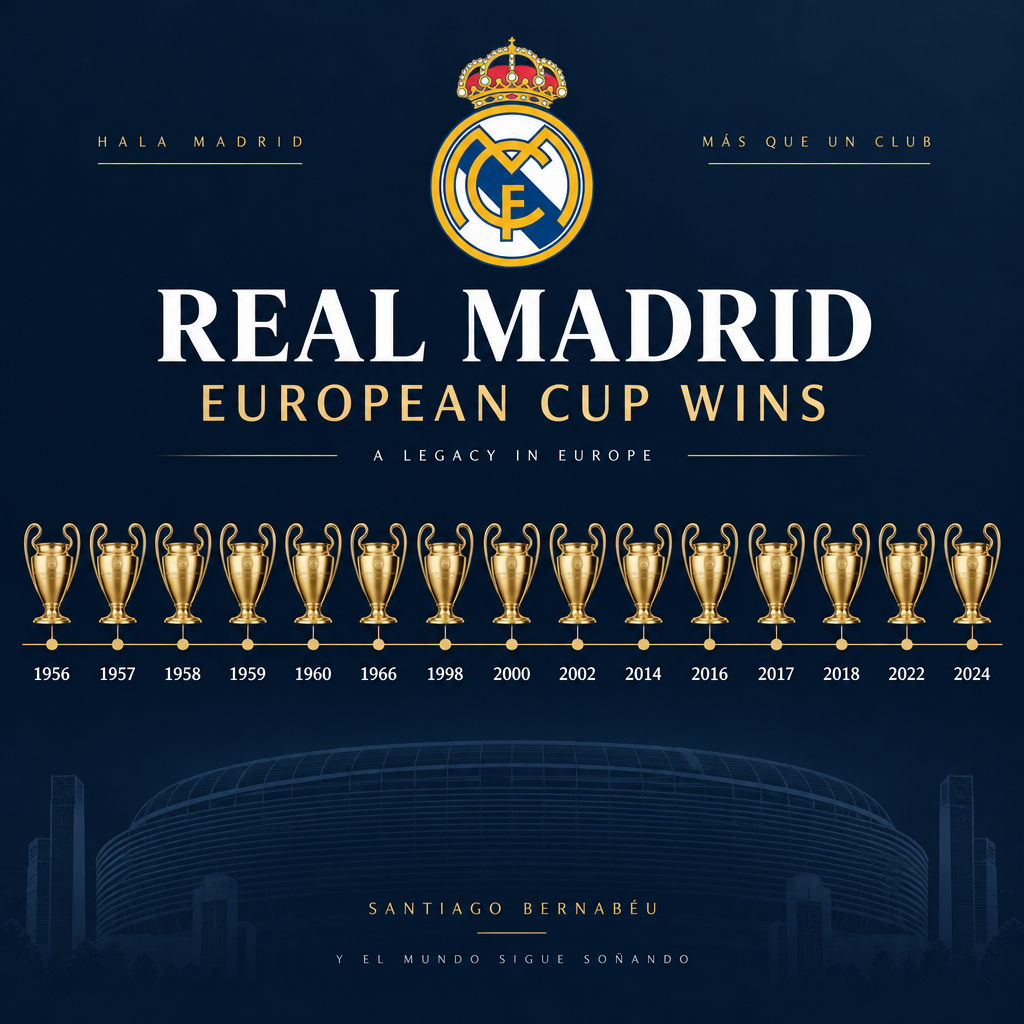
All 15 wins, from the first final in Paris to Wembley:
| Season | Opponent | Score | Venue |
|---|---|---|---|
| 1955-56 | Stade de Reims | 4-3 | Parc des Princes, Paris |
| 1956-57 | Fiorentina | 2-0 | Santiago Bernabéu, Madrid |
| 1957-58 | AC Milan | 3-2 (aet) | Heysel, Brussels |
| 1958-59 | Stade de Reims | 2-0 | Neckarstadion, Stuttgart |
| 1959-60 | Eintracht Frankfurt | 7-3 | Hampden Park, Glasgow |
| 1965-66 | Partizan | 2-1 | Heysel, Brussels |
| 1997-98 | Juventus | 1-0 | Amsterdam ArenA |
| 1999-00 | Valencia | 3-0 | Stade de France, Saint-Denis |
| 2001-02 | Bayer Leverkusen | 2-1 | Hampden Park, Glasgow |
| 2013-14 | Atlético Madrid | 4-1 (aet) | Estádio da Luz, Lisbon |
| 2015-16 | Atlético Madrid | 1-1 (5-3 pens) | San Siro, Milan |
| 2016-17 | Juventus | 4-1 | Millennium Stadium, Cardiff |
| 2017-18 | Liverpool | 3-1 | NSC Olimpiyskiy, Kyiv |
| 2021-22 | Liverpool | 1-0 | Stade de France, Saint-Denis |
| 2023-24 | Borussia Dortmund | 2-0 | Wembley, London |
Madrid has lost only three European Cup finals: to Benfica in 1962, Inter in 1964 and Liverpool in 1981. Since 1981 the club has won all nine finals it has reached.
Real Madrid honours
This table counts major honours through the end of the 2024-25 season. Check the club’s official honours list for anything won since.
| Competition | Titles | Most recent (to 2024-25) |
|---|---|---|
| European Cup / Champions League | 15 | 2024 |
| Spanish league (LaLiga) | 36 | 2023-24 |
| Copa del Rey | 20 | 2023 |
| Supercopa de España | 13 | 2024 |
| UEFA Super Cup | 6 | 2024 |
| UEFA Cup | 2 | 1986 |
| Intercontinental Cup | 3 | 2002 |
| FIFA Club World Cup | 5 | 2022 |
| FIFA Intercontinental Cup | 1 | 2024 |
The league total is the standout domestic number. Barcelona is second, with 28 titles through 2024-25. In Europe, AC Milan is next behind Madrid with seven European Cups.
The FIFA Intercontinental Cup is a newer competition. Madrid won the first edition in December 2024 by beating Pachuca 3-0 in Qatar. That win made Ancelotti the most decorated coach in club history, with 15 trophies, passing Miguel Muñoz.
The Santiago Bernabéu stadium
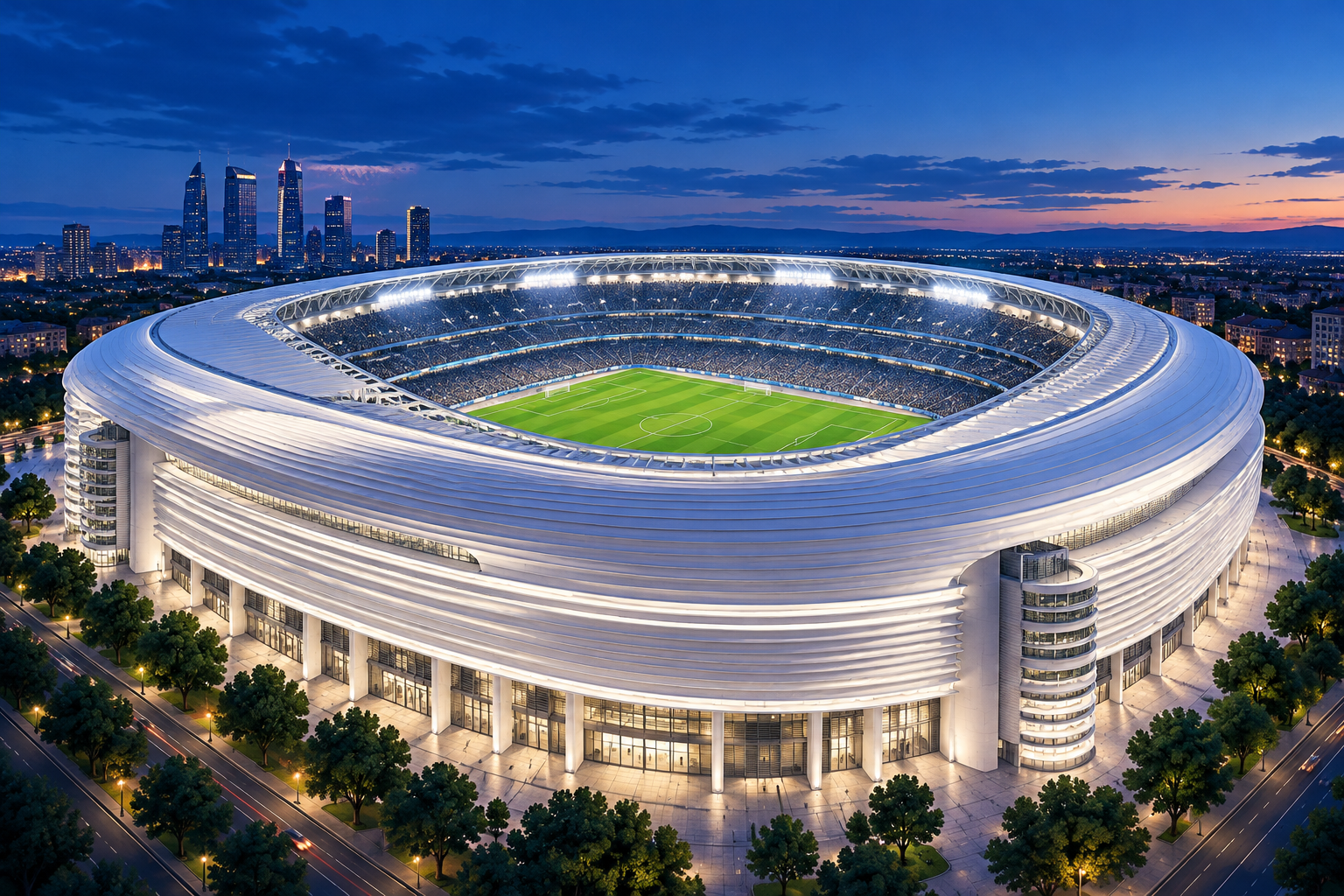
The stadium sits on the Paseo de la Castellana in the Chamartín district, in the middle of the city. It opened on 14 December 1947 as the Nuevo Estadio Chamartín. It was renamed after Santiago Bernabéu in 1955, while he was still president.
The Bernabéu has hosted the biggest games in world football:
- 1964: European Nations’ Cup final, Spain 2-1 Soviet Union
- 1982: World Cup final, Italy 3-1 West Germany
- Four European Cup finals: 1957, 1969, 1980 and 2010 (Inter 2-0 Bayern Munich)
- 2018: Copa Libertadores final second leg, River Plate against Boca Juniors, moved from Buenos Aires after crowd violence
Spain’s bid for the 2030 World Cup, co-hosted with Portugal and Morocco, includes the Bernabéu. It is one of the candidates to host the final.
The rebuild
Work on a full renovation began in 2019. The club kept playing at the stadium throughout. The cost ran well past a billion euros, financed through long-term loans. The result looks almost nothing like the old ground.
The new design has a steel skin wrapped around the old concrete bowl and a retractable roof. It also has a 360-degree video scoreboard and a capacity of more than 80,000. The most unusual feature sits underground.
How the retractable pitch works
- The grass is split into large trays.
- Lifts lower the trays below ground.
- Trays slide into an underground greenhouse.
- Grow lights and irrigation keep the grass alive.
- A hard floor stays open for events.
- Trays return before the next match.
The system lets the club stage concerts and other sports without wrecking the grass. The NFL picked the stadium for its first regular-season game in Spain, played in November 2025. Concerts proved harder. Residents complained about noise in 2024, and the club paused bookings while it worked on sound-proofing.
Madrid’s reserve team, Real Madrid Castilla, and the women’s team play at the Estadio Alfredo Di Stéfano. That smaller ground sits inside the Valdebebas training complex.
Real Madrid players: the 2025-26 squad
Spanish-speaking fans searching for Madrid jugadores usually want the squad list. This is the core of the first-team squad as it stood for the 2025-26 season. Squads change every window, so check the club’s official site for the current list.
| Position | Player | Nationality | Joined |
|---|---|---|---|
| Goalkeeper | Thibaut Courtois | Belgium | 2018, from Chelsea |
| Goalkeeper | Andriy Lunin | Ukraine | 2018, from Zorya Luhansk |
| Defender | Dani Carvajal | Spain | Academy; returned 2013 |
| Defender | Trent Alexander-Arnold | England | 2025, from Liverpool |
| Defender | Éder Militão | Brazil | 2019, from Porto |
| Defender | Antonio Rüdiger | Germany | 2022, free from Chelsea |
| Defender | Dean Huijsen | Spain | 2025, from Bournemouth |
| Defender | Álvaro Carreras | Spain | 2025, from Benfica |
| Defender | Ferland Mendy | France | 2019, from Lyon |
| Midfielder | Federico Valverde | Uruguay | 2016, from Peñarol |
| Midfielder | Aurélien Tchouaméni | France | 2022, from Monaco |
| Midfielder | Eduardo Camavinga | France | 2021, from Rennes |
| Midfielder | Jude Bellingham | England | 2023, from Dortmund |
| Midfielder | Arda Güler | Türkiye | 2023, from Fenerbahçe |
| Midfielder | Franco Mastantuono | Argentina | 2025, from River Plate |
| Forward | Vinícius Júnior | Brazil | 2018, from Flamengo |
| Forward | Kylian Mbappé | France | 2024, free from PSG |
| Forward | Rodrygo | Brazil | 2019, from Santos |
| Forward | Endrick | Brazil | 2024, from Palmeiras |
A few names shape how this team plays.
Kylian Mbappé is the main goal threat. He took the No. 10 shirt in 2025 after Luka Modrić left for AC Milan. His 31 league goals in his first season were the most by a Madrid player since Cristiano Ronaldo.
Vinícius Júnior won FIFA’s The Best award for 2024 and finished second in the 2024 Ballon d’Or. He also scored in two Champions League finals.
Jude Bellingham scored 19 league goals in his first season, 2023-24, which was LaLiga’s title-winning campaign. He was named LaLiga’s player of the season.
Arda Güler was a squad player under Ancelotti. He moved into a more central role after Xabi Alonso arrived. He gives the midfield its creative left foot.
Federico Valverde is the engine. He has played right-back, central midfield and wide midfield, depending on the coach’s needs.
The 2025 summer signings showed a clear plan. Alexander-Arnold, Huijsen and Carreras rebuilt the back line. Modrić and Lucas Vázquez left that summer, ending two long Madrid careers.
Club legends and records
All-time top scorers
Goals in all official competitions:
| Player | Goals | Appearances | Years |
|---|---|---|---|
| Cristiano Ronaldo | 450 | 438 | 2009-2018 |
| Karim Benzema | 354 | 648 | 2009-2023 |
| Raúl | 323 | 741 | 1994-2010 |
| Alfredo Di Stéfano | 308 | 396 | 1953-1964 |
| Santillana | 290 | 645 | 1971-1988 |
| Ferenc Puskás | 242 | 262 | 1958-1966 |
| Hugo Sánchez | 208 | 283 | 1985-1992 |
Cristiano scored more goals than he played games, which nobody had come close to at Madrid. Puskás is the other ratio that stands out. He arrived at 31 and still scored almost a goal a game.
Most appearances
Raúl holds the appearance record with 741. Iker Casillas is close behind with 725, followed by Manolo Sanchís (710), Sergio Ramos (671), Benzema (648) and Santillana (645). All of the top three came through the club’s academy, La Fábrica.
Ballon d’Or winners at Madrid
Real Madrid players have won the Ballon d’Or 12 times:
- Alfredo Di Stéfano (1957, 1959)
- Raymond Kopa (1958)
- Luís Figo (2000)
- Ronaldo Nazário (2002)
- Fabio Cannavaro (2006)
- Cristiano Ronaldo (2013, 2014, 2016, 2017)
- Luka Modrić (2018)
- Karim Benzema (2022)
Modrić left in 2025 as the most decorated player in the club’s history, with 28 trophies.
Coaches who defined eras
Three coaches stand above the rest.
Miguel Muñoz won nine league titles and two European Cups as coach between 1960 and 1974. He also won three European Cups as a player.
Zinedine Zidane won three straight Champions Leagues across two spells as coach.
Carlo Ancelotti won three Champions Leagues across his two spells. He left with 15 trophies, the club record.
Real Madrid transfers: how the club buys
Madrid’s transfer policy has moved through clear phases. The Galácticos era bought finished superstars at world-record prices. The modern model is subtler. The club signs elite teenagers early, mostly from Brazil, and pays big money for players in their early twenties.
Landmark signings, with fees as widely reported at the time:
| Player | Year | From | Reported fee |
|---|---|---|---|
| Luís Figo | 2000 | Barcelona | About €62m (release clause) |
| Zinedine Zidane | 2001 | Juventus | About €75m (then a world record) |
| Cristiano Ronaldo | 2009 | Manchester United | £80m (about €94m) |
| Gareth Bale | 2013 | Tottenham | About €100m |
| Eden Hazard | 2019 | Chelsea | About €100m up front |
| Jude Bellingham | 2023 | Borussia Dortmund | €103m up front |
| Kylian Mbappé | 2024 | Paris Saint-Germain | Free (contract expired) |
The Hazard deal is the cautionary tale. Injuries wrecked his four seasons, and he left in 2023 with seven league goals.
Free transfers are now a core tool. Under the bosman rule, a player whose contract has expired can move without a fee. A player in the last six months of his deal can also agree a pre-contract with a club abroad. Madrid used that route for David Alaba (2021), Antonio Rüdiger (2022) and Mbappé (2024). Alexander-Arnold’s 2025 move came close to being a free one. Madrid paid Liverpool a small fee only to release him early for the Club World Cup.
The Brazilian pipeline is the other pillar. Vinícius was signed at 16 and Rodrygo at 17. Endrick was agreed at 16 and arrived once he turned 18, because FIFA rules generally bar international transfers of minors. Each deal required patience, and two of the three became stars.
Rivalries: El Clásico and the Madrid derby
Real Madrid vs Barcelona
El Clásico is the biggest club fixture in world football by global audience. The rivalry draws on politics as much as sport. Madrid is the capital and the seat of central government, while Barcelona carries Catalan identity.
The Di Stéfano saga in 1953 and Figo’s defection in 2000 are the two transfer flashpoints. The all-time head-to-head is close. Only a handful of wins separate the clubs across well over 250 competitive meetings.
Recent swings have been violent. Madrid beat Barcelona 4-1 in the January 2024 Supercopa final. Barcelona then won all four meetings in 2024-25, including a 4-0 at the Bernabéu and a 5-2 in the Supercopa final.
Real Madrid vs Atlético Madrid
The Madrid derby has become one of Europe’s fiercest rivalries. Madrid beat Atlético in the 2014 and 2016 Champions League finals. The two clubs met again in the 2024-25 round of 16. That tie ended in a penalty shootout and one of the strangest rulings in recent memory, covered below.
Atlético’s best moments in the fixture are domestic. They won the 2013 Copa del Rey final at the Bernabéu and the 2014 league title.
Laws of the Game moments involving Real Madrid
Real Madrid’s big nights have produced some of the most debated refereeing calls of the past decade. Three stand out for anyone who follows the Laws.
Julián Álvarez’s double touch (2025)
In March 2025, Madrid and Atlético went to penalties at the Metropolitano. Julián Álvarez slipped as he struck his kick. His standing foot clipped the ball just before his kicking foot sent it into the net. VAR flagged the contact, and referee Szymon Marciniak disallowed the goal. Madrid won the shootout.
The Laws say the kicker must not play the ball a second time before another player touches it. The double touch was accidental, but the Laws made no exception for that. UEFA said the officials had applied the Laws correctly. It also said it would raise the wording with FIFA and the IFAB.
Ref's note
Intent does not matter for a double touch at a penalty. If the kicker touches the ball twice and VAR can see it, the kick fails, however small the contact.
Ajax 2019: one of the first Champions League VAR calls
VAR arrived in the Champions League for the 2018-19 knockout rounds. In the first leg of Ajax against Real Madrid in February 2019, Nicolás Tagliafico headed Ajax ahead. VAR ruled the goal out because Dušan Tadić, in an offside position, had interfered with Thibaut Courtois. Madrid won that night 2-1 but lost the return 4-1 at home, ending their run of European titles.
If you need a refresher on how reviews work, our explainer on the meaning of var covers the process and what can and cannot be reviewed.
Bayern Munich 2017: the case for VAR
Before VAR, the 2017 quarter-final against Bayern ended in fury. Cristiano Ronaldo scored a hat-trick in extra time of the second leg at the Bernabéu. At least one of those goals came from an offside position. Bayern also had Arturo Vidal sent off on a second yellow card that replays suggested was harsh. Calls like these helped push UEFA toward video review.
Money, ownership and the Super League
Member-owned in a world of investors
Spain’s 1990 Sports Law required most professional clubs to become public limited sports companies, known as SADs. Four clubs had enough financial health to stay member-owned: Real Madrid, Barcelona, Athletic Club and Osasuna. That is why Madrid’s members, not shareholders, still elect the president.
The club’s statutes make it very hard to run for president. Candidates need long membership and a large personal bank guarantee. Critics say those rules keep the incumbent in place. Supporters say they stop outsiders from buying power.
The first billion-euro club
Real Madrid led the Deloitte Football Money League published in January 2025. It became the first club to pass €1 billion in revenue in a single season, with its 2023-24 figures. The rebuilt Bernabéu drives much of the growth through match-day income, tours, shops and events.
That revenue matters under the spending rules. UEFA’s squad cost ratio limits spending on wages, transfers and agents’ fees to 70% of revenue from 2025-26. LaLiga runs its own squad cost limit for each club. A club earning more than €1 billion has more room under both systems than almost anyone else.
The European Super League
Pérez was the public face of the European Super League launched in April 2021. Twelve clubs signed up. The plan collapsed within 48 hours after fan protests, especially in England, and most clubs walked away. Madrid and Barcelona stayed.
In December 2023, the Court of Justice of the European Union ruled on the case. It found that UEFA and FIFA’s rules on approving new competitions breached EU competition law. The ruling did not approve any particular Super League. The project’s promoter, A22 Sports Management, has since pitched a revised multi-division format. Madrid remains its most powerful backer.
Real Madrid beyond the men’s first team
Real Madrid Femenino
The women’s team began in 2020, when the club took over CD Tacón, a Madrid women’s club. Growth has been quick. Real Madrid Femenino has become Barcelona’s closest challenger in Liga F and now plays regularly in the Women’s Champions League. A league title is still the missing piece.
Real Madrid Castilla and La Fábrica
The academy, La Fábrica (“the Factory”), produced Raúl, Casillas, Guti, Carvajal and Nacho. Castilla, the reserve team, has its own place in history. In 1980 it reached the Copa del Rey final and faced the Real Madrid first team. Castilla lost 6-1, but it qualified for the 1980-81 Cup Winners’ Cup because the senior side had already qualified for the European Cup.
Spanish rules bar reserve teams from playing in the same division as their first team. Castilla plays in the lower tiers, most recently Primera Federación.
Real Madrid Baloncesto
The basketball section is as dominant in its sport as the football team. It has won the EuroLeague a record 11 times, most recently in 2023. It shares the club’s colours, members and identity.
Real Madrid in the United States
American audiences have seen Madrid up close for years through summer tours. The 2025 FIFA Club World Cup brought the club to the States for a competitive tournament. Madrid topped a group with Al-Hilal, Pachuca and Red Bull Salzburg, then beat Juventus and Borussia Dortmund in the knockout rounds. PSG ended the run, winning the semi-final 4-0 at MetLife Stadium in New Jersey.
The tournament was Xabi Alonso’s first as coach. It showed early signs of his approach, with a higher press and more structured build-up play than under Ancelotti.
The Bernabéu also went the other way. It hosted an NFL regular-season game in November 2025, the league’s first in Spain. Madrid’s commercial push into the United States, through tours, broadcast deals and stadium events, is now a core part of how the club grows its revenue.
FAQ
How many Champions League titles has Real Madrid won?
Real Madrid has won 15 European Cups, a record. Six came in the old European Cup format (1956-60 and 1966). Nine have come in the Champions League era, most recently against Borussia Dortmund at Wembley in 2024.
How many La Liga titles does Real Madrid have?
Real Madrid had 36 Spanish league titles at the end of the 2024-25 season, the most of any club. Barcelona was second with 28. The 36th came in 2023-24.
Who owns Real Madrid?
The club’s members, the socios, own Real Madrid. It is one of four Spanish professional clubs that never became a public limited sports company. Members elect the president, currently Florentino Pérez.
Who is Real Madrid’s all-time top scorer?
Cristiano Ronaldo, with 450 goals in 438 official games between 2009 and 2018. Karim Benzema is second with 354 and Raúl third with 323.
What is the capacity of the Santiago Bernabéu?
After the renovation that began in 2019, the Bernabéu holds more than 80,000 spectators. It has a retractable roof and a pitch that can be stored underground.
Who is the Real Madrid coach?
Xabi Alonso was appointed in summer 2025, replacing Carlo Ancelotti, who left to coach Brazil. Alonso won the Champions League as a Madrid player in 2014. He previously coached Bayer Leverkusen to an unbeaten Bundesliga title in 2023-24.
Why is the club called Real Madrid?
“Real” means “royal” in Spanish. King Alfonso XIII granted the title in 1920, and the crown was added to the crest at the same time.